Heritagescapes

We are mapping a heritage ecology of the metropolis of Madrid presented through theories, histories and designs.

A Critical Mapping of the Metropolitan Cultural Landscape: Future Heritages

Research project developed by the Cultural Landscape Research Group GIPC of the Madrid School of Architecture at the Universidad Politécnica de Madrid, with the participation of the ADAPTA Research Group at the Universidad Complutense de Madrid. 
Grant PID2022-140500NB-I00 funded by: 

The Frontline Around Madrid: Comparison Between Battle Maps and War Remnants Density Maps of the Spanish Civil War in Madrid

Nicolás Mariné

Curating Heritage. On the Future of the Past in the Everyday Landscape of the Metropolis of Madrid

Rodrigo de la O and Eduardo de Nó

Everyday heritage: Representation and landscape in the region of Madrid

David Escudero and Diego Toribio

Architecture and landscapes for agricultural research in Madrid: documenting scientific and technological heritage

Rodrigo de la O and Eduardo de Nó

Are We What We Eat? A Heritage Perspective on the Agri-food Landscapes of the Madrid Region

David Escudero, Beatriz Pereira

Water to Feed Madrid: 18 km of Orchards and Nurseries Along the Course of the Canalillo

Carmen Toribio

Gardens of yesterday and today, their persistence in the City of Madrid: Comparative study of the Transformation of Private Gardens in Madrid

Lucía Gamboa Sánchez Blanco

Vestige, Signal and Onset of an Event: Sundays at the Rastro

Marina Gil Escalada

Reclaiming the City Through Its River: The Case of the Manzanares

Claudia Rivera Lario

Domestic Architecture in the Sierra de Guadarrama: 20th Century

Guillermo García Prieto

Industrial Madrid: evolution and permanences Around Atocha

Marta Abadín García

Devices of the Real, Collective Devices

Carlo Udina Rodríguez

Between the Playful and the Working-Class: An Atlas of Goya’s Madrid

Juan Castro Sánchez

Towards a Master Plan for the Landscape of Light: Paseo del Prado and Buen Retiro, Landscape of Arts and Sciences

Pablo Jaque Valdés

From water to landscape: the transformation of the Royal Site of Aranjuez through Hydraulic Engineering

Carlos Corisa Andarias

From the kitchen to the landscape. Architectures of Cocido in Madrid.

Beatriz Pereira

Among productive landscapes: the former El Águila brewery in Villaverde, Madrid.

Diego Sacristán

Adaptive reuse and heritage practice: Origins, meanings and strategies

Graziella Trovato

Unveiling Madrid’s Visual Imagery: An Ongoing Attempt

David Escudero

Navigating the Meaques Stream in the Casa de Campo

Clara Cernou

The water footprints of enlightened Madrid and the hydraulic legacy of Juan de Villanueva

Eugenia Abejón

Transhumance Landscapes and Nature-Based Tourism

Cecilia Arnaiz and Marifé Schmitz

Castle of Villaviciosa de Odón: A Scientific Heritage of Forestry Research and Education

Eduardo de Nó

Heritage Networks in Villaverde’s Industrial Landscape

Rafael Guerrero

Ecology of the Royal Sites: The Livestock Trails of El Escorial

Eva Calderón

Co-Design in Urban Framing

Finca formativa "Huerto El Pozo"

The GIPC

Rethinking Public Spaces through Urban Farming

Concha Lapayese, Francisco Arques y Diego Martín-Sánchez

Unveiling Agricultural Heritage

Marina López-Sánchez

Historic Nurseries: A Cultural and Natural Legacy in Transformation

Carmen Toribio

Hydraulic Heterotopias: The Image of Technique

Carmen Toribio

Surrounding the Non-Urbanized Villa de Vallecas

Marina López-Sánchez

Curating Heritage Ecologies

Ecology of the Royal Sites: The Livestock Trails of El Escorial

MWP-II
MAPPING CULTURAL ASSETS AND
PROTECTED LANDSCAPES
Info

Supervised by Rodrigo de la O, Eva Calderón explores the benefits of considering this royal site as part of Madrid’s green infrastructure.

The Royal Sites form a unique territorial heritage system that has structured the landscape around Madrid from its beginnings to the present day. These sites reached their political and economic significance under the reign of Philip II, who established them as seasonal royal residences. Aranjuez, El Escorial, and El Pardo stand out as emblematic examples. Each was carefully chosen not only for its strategic location but also for the richness of its natural surroundings, landscapes that today harbor remarkable biodiversity. Their preservation for historical and cultural values halted urban expansion and, in doing so, safeguarded their ecological wealth.

Diagram of the location of the Royal Sites prepared by the author and based on The Royal Sites and the territory (Ángel Navarro Madrid, 2002).

Diagram of the location of the Royal Sites prepared by the author and based on The Royal Sites and the territory (Ángel Navarro Madrid, 2002).

However, in today’s rapidly transforming region, the Royal Sites face new challenges. Madrid is among the Spanish regions most severely affected by territorial fragmentation. The city’s relentless demographic growth has fueled urban expansion, disrupted fluvial systems, and carved up natural landscapes with large-scale transport infrastructures. The Royal Sites are one of these fragmented systems, reduced to isolated green islands scattered in a sea of development. How, then, can we rethink this territory to reintegrate the Royal Sites into a broader and unified ecological and cultural system?

A promising answer may lie in the lens of human ecology. Recognizing nature as a critical design principle, the Community of Madrid is developing two ambitious landscape architecture projects aimed at reordering the metropolitan territory from an ecological perspective. On the one hand, the Arco Verde is a vast ecological corridor designed to link 25 municipalities with the region’s three major Regional Parks, creating new biodiversity hubs and healing fragmented ecosystems. On the other hand, the Metropolitan Forest aspires to become one of Europe’s largest green infrastructures: a 75-kilometer forest ring encircling Madrid, connecting the Regional Parks with one another and with the Sierra de Guadarrama National Park, offering an array of ecosystem services in the process. Strikingly, neither of these initiatives includes the Royal Sites within their frameworks. And so, a crucial question emerges: what role could these historical landscapes play in shaping the green infrastructure of tomorrow?

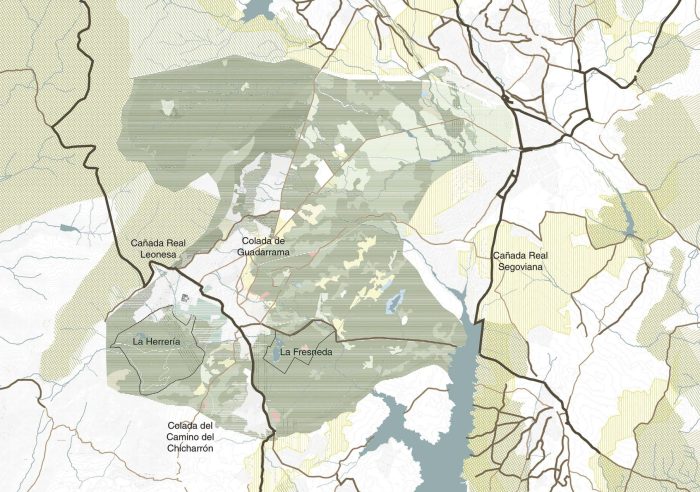
Cartography prepared by the author of the immediate surroundings of the Royal Site of San Lorenzo de El Escorial, highlighting the Protected Natural Areas, the Natura 2000 Network, the Ecological Corridors, and the Royal Cañadas.

Cartography prepared by the author of the immediate surroundings of the Royal Site of San Lorenzo de El Escorial, highlighting the Protected Natural Areas, the Natura 2000 Network, the Ecological Corridors, and the Royal Cañadas.

Eva Calderón takes up this question through an in-depth cartographic research. Her work reveals not only the essential contributions the Royal Sites make to the regional ecological network, but also the profound compatibility between their natural and cultural values. Moreover, she uncovers the subtle connections these sites maintain with other green infrastructures—such as the Natura 2000 Network and the system of Protected Natural Areas—through a network of hydraulic systems, vías pecuarias, and public spaces.

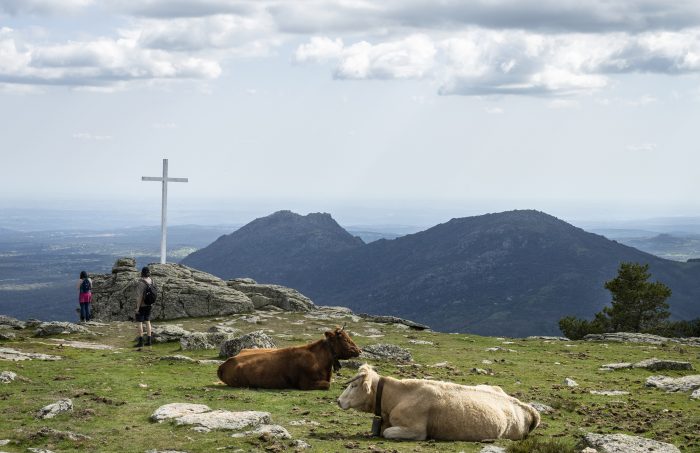
Photograph of cattle in El Escorial taken by Alfredo Cáliz and obtained through the Regional Archive of the Community of Madrid.

Photograph of cattle in El Escorial taken by Alfredo Cáliz and obtained through the Regional Archive of the Community of Madrid.

Read the full article

Calderón Martín, Eva (2024). Ecología de los Reales Sitios alrededor de Madrid. (Trabajo Fin de Grado, Universidad Politécnica de Madrid).

Diagram of the location of the Royal Sites prepared by the author and based on The Royal Sites and the territory (Ángel Navarro Madrid, 2002).
Cartography prepared by the author of the immediate surroundings of the Royal Site of San Lorenzo de El Escorial, highlighting the Protected Natural Areas, the Natura 2000 Network, the Ecological Corridors, and the Royal Cañadas.
Photograph of cattle in El Escorial taken by Alfredo Cáliz and obtained through the Regional Archive of the Community of Madrid.