Heritagescapes

We are mapping a heritage ecology of the metropolis of Madrid presented through theories, histories and designs.

A Critical Mapping of the Metropolitan Cultural Landscape: Future Heritages

Research project developed by the Cultural Landscape Research Group GIPC of the Madrid School of Architecture at the Universidad Politécnica de Madrid, with the participation of the ADAPTA Research Group at the Universidad Complutense de Madrid. 
Grant PID2022-140500NB-I00 funded by: 

The Frontline Around Madrid: Comparison Between Battle Maps and War Remnants Density Maps of the Spanish Civil War in Madrid

Nicolás Mariné

Curating Heritage. On the Future of the Past in the Everyday Landscape of the Metropolis of Madrid

Rodrigo de la O and Eduardo de Nó

Everyday heritage: Representation and landscape in the region of Madrid

David Escudero and Diego Toribio

Architecture and landscapes for agricultural research in Madrid: documenting scientific and technological heritage

Rodrigo de la O and Eduardo de Nó

Are We What We Eat? A Heritage Perspective on the Agri-food Landscapes of the Madrid Region

David Escudero, Beatriz Pereira

Water to Feed Madrid: 18 km of Orchards and Nurseries Along the Course of the Canalillo

Carmen Toribio

Gardens of yesterday and today, their persistence in the City of Madrid: Comparative study of the Transformation of Private Gardens in Madrid

Lucía Gamboa Sánchez Blanco

Vestige, Signal and Onset of an Event: Sundays at the Rastro

Marina Gil Escalada

Reclaiming the City Through Its River: The Case of the Manzanares

Claudia Rivera Lario

Domestic Architecture in the Sierra de Guadarrama: 20th Century

Guillermo García Prieto

Industrial Madrid: evolution and permanences Around Atocha

Marta Abadín García

Devices of the Real, Collective Devices

Carlo Udina Rodríguez

Between the Playful and the Working-Class: An Atlas of Goya’s Madrid

Juan Castro Sánchez

Towards a Master Plan for the Landscape of Light: Paseo del Prado and Buen Retiro, Landscape of Arts and Sciences

Pablo Jaque Valdés

From water to landscape: the transformation of the Royal Site of Aranjuez through Hydraulic Engineering

Carlos Corisa Andarias

From the kitchen to the landscape. Architectures of Cocido in Madrid.

Beatriz Pereira

Among productive landscapes: the former El Águila brewery in Villaverde, Madrid.

Diego Sacristán

Adaptive reuse and heritage practice: Origins, meanings and strategies

Graziella Trovato

Unveiling Madrid’s Visual Imagery: An Ongoing Attempt

David Escudero

Navigating the Meaques Stream in the Casa de Campo

Clara Cernou

The water footprints of enlightened Madrid and the hydraulic legacy of Juan de Villanueva

Eugenia Abejón

Transhumance Landscapes and Nature-Based Tourism

Cecilia Arnaiz and Marifé Schmitz

Castle of Villaviciosa de Odón: A Scientific Heritage of Forestry Research and Education

Eduardo de Nó

Heritage Networks in Villaverde’s Industrial Landscape

Rafael Guerrero

Ecology of the Royal Sites: The Livestock Trails of El Escorial

Eva Calderón

Co-Design in Urban Framing

Finca formativa "Huerto El Pozo"

The GIPC

Rethinking Public Spaces through Urban Farming

Concha Lapayese, Francisco Arques y Diego Martín-Sánchez

Unveiling Agricultural Heritage

Marina López-Sánchez

Historic Nurseries: A Cultural and Natural Legacy in Transformation

Carmen Toribio

Hydraulic Heterotopias: The Image of Technique

Carmen Toribio

Surrounding the Non-Urbanized Villa de Vallecas

Marina López-Sánchez

Curating Heritage Ecologies

Heritage Networks in Villaverde’s Industrial Landscape

MWP-I
MAPPING INFRASTRUCTURES AND
NATURECULTURE VALUES
Info

Supervised by Rodrigo de la O, Rafael Guerrero’s research examines the spatial impact of six industries in Madrid’s Villaverde district: Boetticher y Navarro, Marconi, Euskalduna, Butano, Renfe, and Automovilismo del Ejército de Tierra.

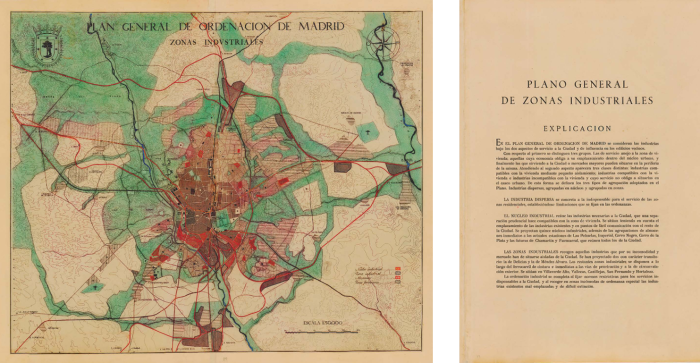
In 1939, the Spanish Civil War had come to an end, leaving Franco’s regime in charge of rebuilding a country devastated by the conflict. That same year, Pedro Bidagor presented the drafting of the General Urban Development Plan for Madrid at the National Assembly of Architects. The plan aimed to lay down the urban planning foundations for rebuilding the war-torn Spanish capital. The Plan placed special emphasis on the industrial development of the metropolis, proposing a spatial organisation of industry grounded in the capital’s geographic and functional logic. The envisioned city resembled a planetary system: a central urban nucleus encircled by a green belt, around which revolved the so-called ‘satellite settlements’—factory towns conceived to serve the great city. These suburban enclaves were destined to host the largest and most strategic industrial zones, linked to Madrid by an expanding network of roads and railways. The planning of these satellite towns followed a deliberate hierarchy of landscapes. While the northern and western zones sought to preserve the ‘Velázquez landscapes’ and the lush woodlands, the dry, austere plains of the south and east, shaped by the Castilian plateau, were deemed ideal terrain for industrial expansion. Among the southern industrial settlements, one stood out for the scale of its economic and territorial impact: the district of Villaverde.

The Industrial Zones Development Plan was included in the 1946 General Development Plan for Madrid, also known as the Bidagor Plan. Villaverde was planned as a southern industrial zone with good rail and road connections.

The Industrial Zones Development Plan was included in the 1946 General Development Plan for Madrid, also known as the Bidagor Plan. Villaverde was planned as a southern industrial zone with good rail and road connections.

The roots of Villaverde’s industrialisation can be traced back to the arrival of the railway in 1850 and the emergence of small ceramic factories in the 1930s. However, it was under the Bidagor Plan that Villaverde went from being a small village to become the main productive centre of Madrid. Taking advantage of the availability of large areas of land and the direct connection with the communication lines to the capital, between 1940 and 1970, large industrial complexes of companies such as Marconi, Boetticher y Navarro, Campsa or Barreiros Diesel were installed in the district. The result was a heterogeneous landscape made up of large independent complexes that were semi-isolated from each other but connected to the big city by the network of transport infrastructure.

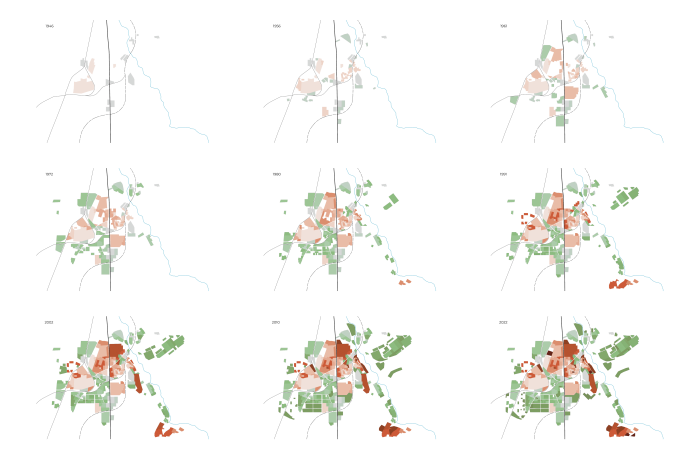
Significant industrial and urban development took place in Villaverde between 1946 and 2022. Since 1980, the area has evolved into a new, partially post-industrial landscape. The map illustrates these changes, marking industrial areas in green and urban areas in red.

Significant industrial and urban development took place in Villaverde between 1946 and 2022. Since 1980, the area has evolved into a new, partially post-industrial landscape. The map illustrates these changes, marking industrial areas in green and urban areas in red.

Industrial development also brought with it demographic growth. The need to house the workers who came from rural areas to work in the new industries resulted in the promotion of large housing colonies by the companies such as those built by Boetticher y Navarro, Marconi or Butano. With all the necessary social facilities, these ‘self-sufficient cities’ promised a dignified life for the workers: housing, gardens, swimming pools, schools and even football pitches.

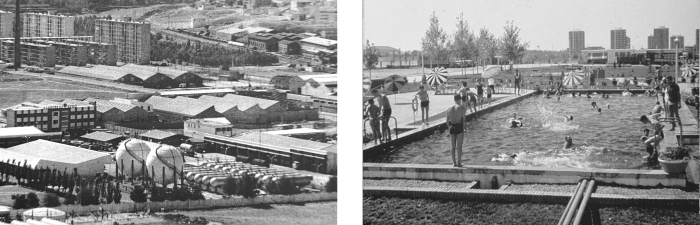
On the right is an aerial view of the BUTANO SA facilities in Villaverde. On the left is a swimming pool for workers at the BUTANO SA workers' village. These photographs are taken from the book Villaverde by Miguel Ángel García Castrillo and José María Sánchez Molledo (Madrid: Temporae Libros, 2017).

On the right is an aerial view of the BUTANO SA facilities in Villaverde. On the left is a swimming pool for workers at the BUTANO SA workers' village. These photographs are taken from the book Villaverde by Miguel Ángel García Castrillo and José María Sánchez Molledo (Madrid: Temporae Libros, 2017).

The early 1970s marked the beginning of Villaverde’s industrial decline. The exhaustion of available strategic land and the rising cost of property brought the district’s once-thriving industrial growth to a halt, stalling population expansion along with it. One by one, companies shut down and their factories were dismantled or left to decay in silence. This process of industrial hollowing out threatened to erase both the material presence and the intangible legacy of the productive activity that had defined Villaverde landscape and identity. Today, Villaverde remains as one of the most significant areas in relation to the social and economic history of Madrid’s industry. Following the guidelines provided by the National Plan for Industrial Heritage, Madrid City Council is working to preserve, restore, or reimagine these remnants of local identity through initiatives such as guided tours, publications on industrial heritage, and the rehabilitation of iconic sites like La Catedral de Boetticher y Navarro, now being transformed into a hub for urban innovation.

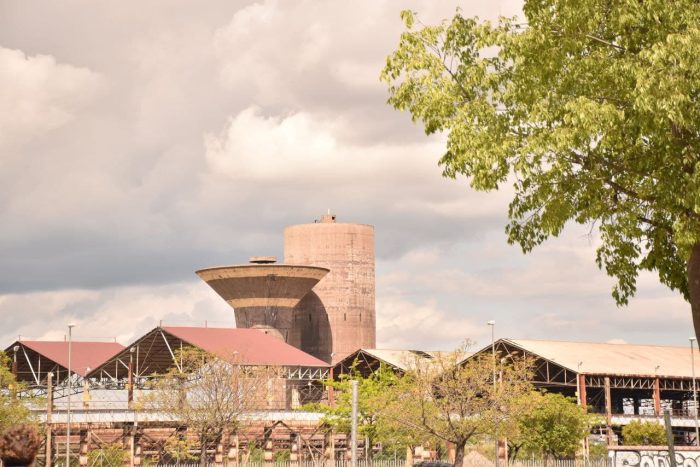
Some remains of old, disused industrial structures dominate the urban landscape of Villaverde, shaping the identity of the city's southern border. "Hacia la recuperación del área industrial de Villaverde", Plataforma Nave Boetticher, https://plataformanaveboetticher.wordpress.com/recuperacion-area-industrial/ (accessed June 3, 2025).

Some remains of old, disused industrial structures dominate the urban landscape of Villaverde, shaping the identity of the city's southern border. "Hacia la recuperación del área industrial de Villaverde", Plataforma Nave Boetticher, https://plataformanaveboetticher.wordpress.com/recuperacion-area-industrial/ (accessed June 3, 2025).

Read the full article

Guerrero Ureña, Rafael (2024). Patrimonio industrial en la metrópoli de Madrid: Villaverde, redes y paisajes (Trabajo Fin de Grado, Universidad Politécnica de Madrid).

The Industrial Zones Development Plan was included in the 1946 General Development Plan for Madrid, also known as the Bidagor Plan. Villaverde was planned as a southern industrial zone with good rail and road connections.
Significant industrial and urban development took place in Villaverde between 1946 and 2022. Since 1980, the area has evolved into a new, partially post-industrial landscape. The map illustrates these changes, marking industrial areas in green and urban areas in red.
On the right is an aerial view of the BUTANO SA facilities in Villaverde. On the left is a swimming pool for workers at the BUTANO SA workers' village. These photographs are taken from the book Villaverde by Miguel Ángel García Castrillo and José María Sánchez Molledo (Madrid: Temporae Libros, 2017).
Some remains of old, disused industrial structures dominate the urban landscape of Villaverde, shaping the identity of the city's southern border. "Hacia la recuperación del área industrial de Villaverde", Plataforma Nave Boetticher, https://plataformanaveboetticher.wordpress.com/recuperacion-area-industrial/ (accessed June 3, 2025).