Heritagescapes

We are mapping a heritage ecology of the metropolis of Madrid presented through theories, histories and designs.

A Critical Mapping of the Metropolitan Cultural Landscape: Future Heritages

Research project developed by the Cultural Landscape Research Group GIPC of the Madrid School of Architecture at the Universidad Politécnica de Madrid, with the participation of the ADAPTA Research Group at the Universidad Complutense de Madrid. 
Grant PID2022-140500NB-I00 funded by: 

The Frontline Around Madrid: Comparison Between Battle Maps and War Remnants Density Maps of the Spanish Civil War in Madrid

Nicolás Mariné

Curating Heritage. On the Future of the Past in the Everyday Landscape of the Metropolis of Madrid

Rodrigo de la O and Eduardo de Nó

Everyday heritage: Representation and landscape in the region of Madrid

David Escudero and Diego Toribio

Architecture and landscapes for agricultural research in Madrid: documenting scientific and technological heritage

Rodrigo de la O and Eduardo de Nó

Are We What We Eat? A Heritage Perspective on the Agri-food Landscapes of the Madrid Region

David Escudero, Beatriz Pereira

Water to Feed Madrid: 18 km of Orchards and Nurseries Along the Course of the Canalillo

Carmen Toribio

Gardens of yesterday and today, their persistence in the City of Madrid: Comparative study of the Transformation of Private Gardens in Madrid

Lucía Gamboa Sánchez Blanco

Vestige, Signal and Onset of an Event: Sundays at the Rastro

Marina Gil Escalada

Reclaiming the City Through Its River: The Case of the Manzanares

Claudia Rivera Lario

Domestic Architecture in the Sierra de Guadarrama: 20th Century

Guillermo García Prieto

Industrial Madrid: evolution and permanences Around Atocha

Marta Abadín García

Devices of the Real, Collective Devices

Carlo Udina Rodríguez

Between the Playful and the Working-Class: An Atlas of Goya’s Madrid

Juan Castro Sánchez

Towards a Master Plan for the Landscape of Light: Paseo del Prado and Buen Retiro, Landscape of Arts and Sciences

Pablo Jaque Valdés

From water to landscape: the transformation of the Royal Site of Aranjuez through Hydraulic Engineering

Carlos Corisa Andarias

From the kitchen to the landscape. Architectures of Cocido in Madrid.

Beatriz Pereira

Among productive landscapes: the former El Águila brewery in Villaverde, Madrid.

Diego Sacristán

Adaptive reuse and heritage practice: Origins, meanings and strategies

Graziella Trovato

Unveiling Madrid’s Visual Imagery: An Ongoing Attempt

David Escudero

Navigating the Meaques Stream in the Casa de Campo

Clara Cernou

The water footprints of enlightened Madrid and the hydraulic legacy of Juan de Villanueva

Eugenia Abejón

Transhumance Landscapes and Nature-Based Tourism

Cecilia Arnaiz and Marifé Schmitz

Castle of Villaviciosa de Odón: A Scientific Heritage of Forestry Research and Education

Eduardo de Nó

Heritage Networks in Villaverde’s Industrial Landscape

Rafael Guerrero

Ecology of the Royal Sites: The Livestock Trails of El Escorial

Eva Calderón

Co-Design in Urban Framing

Finca formativa "Huerto El Pozo"

The GIPC

Rethinking Public Spaces through Urban Farming

Concha Lapayese, Francisco Arques y Diego Martín-Sánchez

Unveiling Agricultural Heritage

Marina López-Sánchez

Historic Nurseries: A Cultural and Natural Legacy in Transformation

Carmen Toribio

Hydraulic Heterotopias: The Image of Technique

Carmen Toribio

Surrounding the Non-Urbanized Villa de Vallecas

Marina López-Sánchez

Curating Heritage Ecologies

Hydraulic Heterotopias: The Image of Technique

MWP-II
MAPPING CULTURAL ASSETS AND
PROTECTED LANDSCAPES
Info

Carmen Toribio discusses the enhancement of the historical hydraulic systems of the Retiro Park through their analysis and mapping.

Traditional hydraulic systems have significantly influenced the urban landscape over time. Although their visibility may be limited, their presence within the contemporary city is evident through the enduring cultural artifacts associated with water, as well as the various activities linked to these systems. This research specifically examines the hydraulic systems of Retiro Park as a paradigmatic example. It posits that these systems represent a heterogeneous heritage that has imparted both material and immaterial legacies to the site, thereby creating a dynamic spatio-temporal narrative that is continuously evolving.

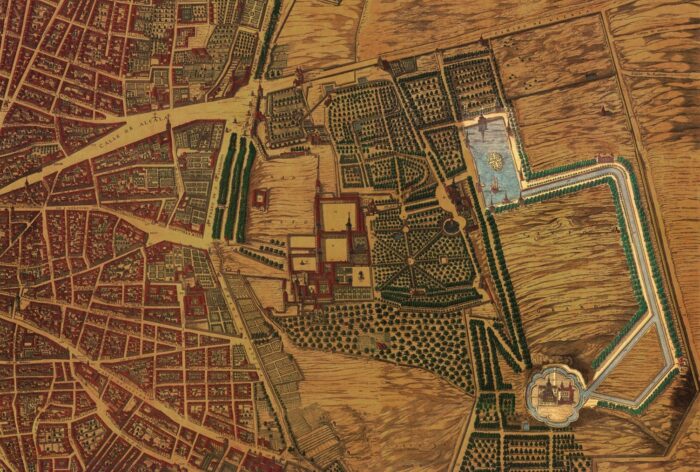
The Estanque Grande, the Río Grande and the Hermitage of San Antonio highlighted in the 1656 map of Madrid by Pedro Teixeira. Prepared by Carmen Toribio based on a Public Domain map.

The Estanque Grande, the Río Grande and the Hermitage of San Antonio highlighted in the 1656 map of Madrid by Pedro Teixeira. Prepared by Carmen Toribio based on a Public Domain map.

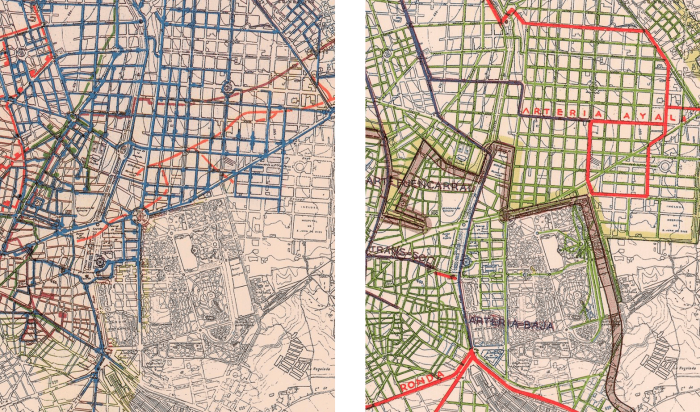
This study focuses on the analysis of the Viaje Alto and Bajo of the Buen Retiro, which are concealed structures that facilitated the transformation of the site into a water-rich landscape, serving as the backdrop for the theatrical performances of the Spanish Golden Age. Over time, these primitive infrastructures evolved into dynamic condensers of activities that enriched the original ensemble with multiple layers of meaning. Remarkably, they remained operational until the 1970s, when increasing urbanization threatened their existence, leading to their replacement by a water supply system from the Canal de Isabel II. This intervention, which has received limited scholarly attention, aimed to modernize the park by substituting perimeter hedgerows and caceras with expansive open meadows irrigated by sprinklers. While this solution enabled more intensive utilization of space, aligning with the site’s transformation into a public park, the technical advancements introduced an image that is now scrutinized through technical, heritage, and environmental lenses. Adopting an interdisciplinary perspective, this research also considers the artistic manifestations inspired by the hydraulic structures, directing attention towards traditional irrigation systems.

Madrid: water supply (1929). Santillana Hydraulic Society Network and Old Voyages (left). Canal de Isabel II (right). National Geographic Institute (IGN).

Madrid: water supply (1929). Santillana Hydraulic Society Network and Old Voyages (left). Canal de Isabel II (right). National Geographic Institute (IGN).

The objective of this study is to analyze and map the hydraulic systems of Retiro Park, both within its confines and in relation to its broader territorial context. It aims to explore the relationships established between various structures, which, through their overlapping and interconnected nature, have contributed to the creation of a palimpsest landscape. This research relies on a diverse array of sources, including documentary, cartographic, and historical photographic materials. It is further enriched by unpublished documents obtained from the Madrid Parks and Gardens Archive, as well as interviews with technicians who have worked within the complex in more recent years.

The study investigates the uses and cultural manifestations associated with water throughout the park’s history, conceptualizing it as a reflection of the heterotopic urban landscape. Additionally, it engages in a critical reflection on the sustainability and relevance of traditional hydraulic systems in the contemporary urban environment. Through this multifaceted approach, the research seeks to illuminate the historical significance and contemporary implications of the hydraulic systems that have shaped Retiro Park.


The Estanque Grande, the Río Grande and the Hermitage of San Antonio highlighted in the 1656 map of Madrid by Pedro Teixeira. Prepared by Carmen Toribio based on a Public Domain map.
Madrid: water supply (1929). Santillana Hydraulic Society Network and Old Voyages (left). Canal de Isabel II (right). National Geographic Institute (IGN).