Heritagescapes

We are mapping a heritage ecology of the metropolis of Madrid presented through theories, histories and designs.

A Critical Mapping of the Metropolitan Cultural Landscape: Future Heritages

Research project developed by the Cultural Landscape Research Group GIPC of the Madrid School of Architecture at the Universidad Politécnica de Madrid, with the participation of the ADAPTA Research Group at the Universidad Complutense de Madrid. 
Grant PID2022-140500NB-I00 funded by: 

The Frontline Around Madrid: Comparison Between Battle Maps and War Remnants Density Maps of the Spanish Civil War in Madrid

Nicolás Mariné

Curating Heritage. On the Future of the Past in the Everyday Landscape of the Metropolis of Madrid

Rodrigo de la O and Eduardo de Nó

Everyday heritage: Representation and landscape in the region of Madrid

David Escudero and Diego Toribio

Architecture and landscapes for agricultural research in Madrid: documenting scientific and technological heritage

Rodrigo de la O and Eduardo de Nó

Are We What We Eat? A Heritage Perspective on the Agri-food Landscapes of the Madrid Region

David Escudero, Beatriz Pereira

Water to Feed Madrid: 18 km of Orchards and Nurseries Along the Course of the Canalillo

Carmen Toribio

Gardens of yesterday and today, their persistence in the City of Madrid: Comparative study of the Transformation of Private Gardens in Madrid

Lucía Gamboa Sánchez Blanco

Vestige, Signal and Onset of an Event: Sundays at the Rastro

Marina Gil Escalada

Reclaiming the City Through Its River: The Case of the Manzanares

Claudia Rivera Lario

Domestic Architecture in the Sierra de Guadarrama: 20th Century

Guillermo García Prieto

Industrial Madrid: evolution and permanences Around Atocha

Marta Abadín García

Devices of the Real, Collective Devices

Carlo Udina Rodríguez

Between the Playful and the Working-Class: An Atlas of Goya’s Madrid

Juan Castro Sánchez

Towards a Master Plan for the Landscape of Light: Paseo del Prado and Buen Retiro, Landscape of Arts and Sciences

Pablo Jaque Valdés

From water to landscape: the transformation of the Royal Site of Aranjuez through Hydraulic Engineering

Carlos Corisa Andarias

From the kitchen to the landscape. Architectures of Cocido in Madrid.

Beatriz Pereira

Among productive landscapes: the former El Águila brewery in Villaverde, Madrid.

Diego Sacristán

Adaptive reuse and heritage practice: Origins, meanings and strategies

Graziella Trovato

Unveiling Madrid’s Visual Imagery: An Ongoing Attempt

David Escudero

Navigating the Meaques Stream in the Casa de Campo

Clara Cernou

The water footprints of enlightened Madrid and the hydraulic legacy of Juan de Villanueva

Eugenia Abejón

Transhumance Landscapes and Nature-Based Tourism

Cecilia Arnaiz and Marifé Schmitz

Castle of Villaviciosa de Odón: A Scientific Heritage of Forestry Research and Education

Eduardo de Nó

Heritage Networks in Villaverde’s Industrial Landscape

Rafael Guerrero

Ecology of the Royal Sites: The Livestock Trails of El Escorial

Eva Calderón

Co-Design in Urban Framing

Finca formativa "Huerto El Pozo"

The GIPC

Rethinking Public Spaces through Urban Farming

Concha Lapayese, Francisco Arques y Diego Martín-Sánchez

Unveiling Agricultural Heritage

Marina López-Sánchez

Historic Nurseries: A Cultural and Natural Legacy in Transformation

Carmen Toribio

Hydraulic Heterotopias: The Image of Technique

Carmen Toribio

Surrounding the Non-Urbanized Villa de Vallecas

Marina López-Sánchez

Curating Heritage Ecologies

From the kitchen to the landscape. Architectures of Cocido in Madrid.

MWP-III
MAPPING AGROECOLOGY AND
SUPPLY CHANNELS
Info

Supervised by David Escudero, Beatriz Pereira studies the spatial dimension of the preparation of cocido in the Madrid region, exploring its implications in architecures, cities, territories and landscapes.

Cocido is a traditional stew of Madrid’s gastronomy. Although its elaboration within the kitchen is quite simple and tedious, the large number of ingredients involved unfolds a series of intricate processes of systematic nature. This is a good example of a recipe whose complexity lies in the process rather than in the preparation. But even so, every time we eat a cocido madrileño, we ignore the phenomena through which the ingredients have passed until they are served on our plate. In each spoonful there is not only broth, chickpeas and pieces of meat; we also ingest markets, spaces of distribution, territories and a bit of tradition. This is not only true for cocido madrileño, the act of eating is trans-scalar and interdependent, yet we often overlook how inherent it is to the architectural, urban and landscape processes that shape our built environment every day and have a direct impact on the health of people, the environment and the Earth’s resources.

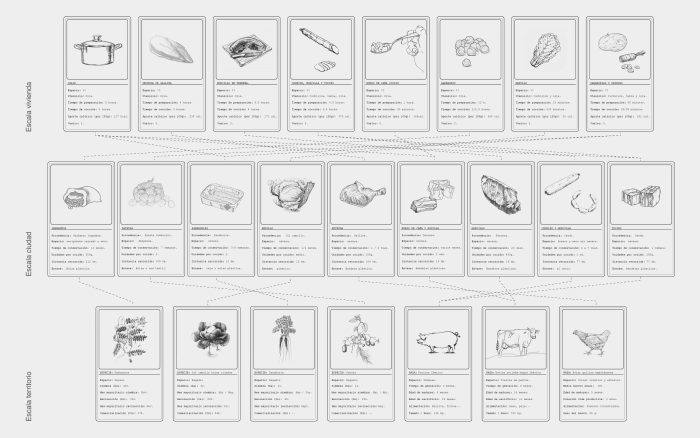
Elements needed for the stew recipe at the scale of the house, the city, and the territory. Diagram created by the author.

Elements needed for the stew recipe at the scale of the house, the city, and the territory. Diagram created by the author.

The research focuses on the spatial dimension of this recipe with an identity character in the region of Madrid, and particularly on revealing what is not seen behind the spoon. To this end, a study of cocido madrileño is proposed at three interrelated scales: the home, the city and the territory. A spatial retrospection is traced from the moment in which we take a spoonful of cocido madrileño to the moment in which that meal was complete units, and even more so, animals and plants. To do this, it is essential to try to construct a meta-recipe that is capable of delving into both the ingredients in their different states and the logistical dynamics that allow them to be prepared at different scales depending on the spaces that make up the system in each one. It begins with a typological analysis of the kitchen according to the ingredients of the stew, then it examines urban spaces from an infrastructural perspective according to the food units, and it ends with a cartographic exploration of the landscapes according to crops and breeding.

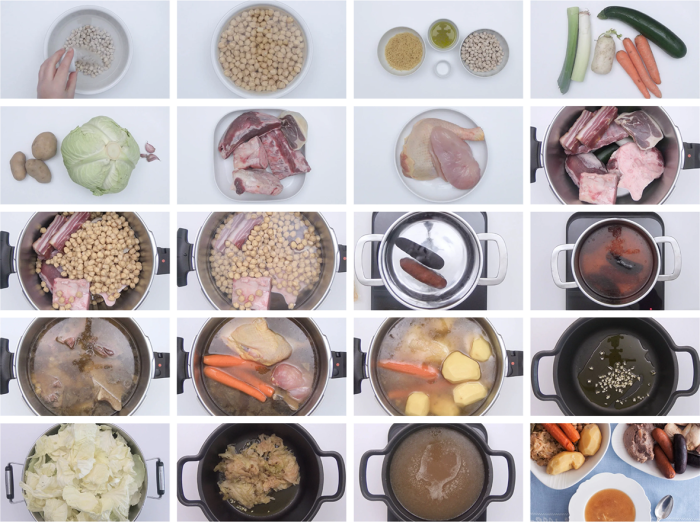
Step-by-step instructions for making cocido. Recipe and photographs by the author.

Step-by-step instructions for making cocido. Recipe and photographs by the author.

On the first scale, once we have studied the transformations of the kitchen since the end of the 19th century, three examples of contemporary kitchens in different contexts are analysed. The parameters are related to the steps of the recipe, so they are studied based on the routes, the actions, the time inside the kitchen and its relationship with the rest of the dwelling.  At the urban scale, we study the great international hegemonic system and its consequences on the commercialisation and distribution of cocido in the city of Madrid. In this context, it explores the possibility of a zero-kilometre cocido madrileño in conjunction with municipal initiatives that are committed to urban agriculture and local distribution channels. In the territory, it is first necessary to understand the qualitative situation of agriculture and livestock farming in the region, in relation to the cocido, and then to cross it with two initiatives of the administration, the Bosque Metropolitano and the Arco Verde, which emerge as spaces of opportunity to value the productive character that nature has historically had and that continues to be key not only in terms of sustainability but also in terms of identity and culture.

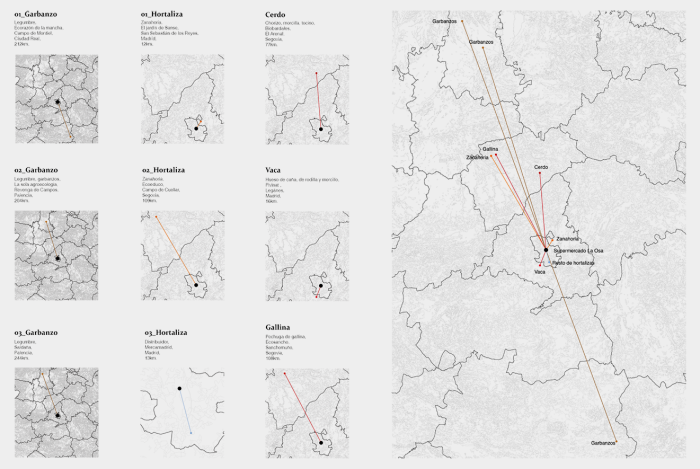
Relationship between La Osa Supermarket and the production locations of the ingredients for traditional cocido. Cartographies of the Madrid region and its surrounding areas by the author.

Relationship between La Osa Supermarket and the production locations of the ingredients for traditional cocido. Cartographies of the Madrid region and its surrounding areas by the author.

The work critically discusses topics that commonly appear to be established, and yet become erroneous, such as the region’s capacity to provide ingredients in a more sustainable way, the possibility of building kitchens adapted to contemporary life in the metropolis, or the gradual increase in municipal interest in food dynamics that result in new spaces of distribution and consumption, among others. In short, the research proposes new readings from the field of architecture that renew the cultural imaginary of a recipe with deep roots in the capital and that make the population aware of, and ultimately involved in, its food dynamics.

Elements needed for the stew recipe at the scale of the house, the city, and the territory. Diagram created by the author.
Step-by-step instructions for making cocido. Recipe and photographs by the author.
Relationship between La Osa Supermarket and the production locations of the ingredients for traditional cocido. Cartographies of the Madrid region and its surrounding areas by the author.