Heritagescapes

We are mapping a heritage ecology of the metropolis of Madrid presented through theories, histories and designs.

A Critical Mapping of the Metropolitan Cultural Landscape: Future Heritages

Research project developed by the Cultural Landscape Research Group GIPC of the Madrid School of Architecture at the Universidad Politécnica de Madrid, with the participation of the ADAPTA Research Group at the Universidad Complutense de Madrid. 
Grant PID2022-140500NB-I00 funded by: 

The Frontline Around Madrid: Comparison Between Battle Maps and War Remnants Density Maps of the Spanish Civil War in Madrid

Nicolás Mariné

Curating Heritage. On the Future of the Past in the Everyday Landscape of the Metropolis of Madrid

Rodrigo de la O and Eduardo de Nó

Everyday heritage: Representation and landscape in the region of Madrid

David Escudero and Diego Toribio

Architecture and landscapes for agricultural research in Madrid: documenting scientific and technological heritage

Rodrigo de la O and Eduardo de Nó

Are We What We Eat? A Heritage Perspective on the Agri-food Landscapes of the Madrid Region

David Escudero, Beatriz Pereira

Water to Feed Madrid: 18 km of Orchards and Nurseries Along the Course of the Canalillo

Carmen Toribio

Gardens of yesterday and today, their persistence in the City of Madrid: Comparative study of the Transformation of Private Gardens in Madrid

Lucía Gamboa Sánchez Blanco

Vestige, Signal and Onset of an Event: Sundays at the Rastro

Marina Gil Escalada

Reclaiming the City Through Its River: The Case of the Manzanares

Claudia Rivera Lario

Domestic Architecture in the Sierra de Guadarrama: 20th Century

Guillermo García Prieto

Industrial Madrid: evolution and permanences Around Atocha

Marta Abadín García

Devices of the Real, Collective Devices

Carlo Udina Rodríguez

Between the Playful and the Working-Class: An Atlas of Goya’s Madrid

Juan Castro Sánchez

Towards a Master Plan for the Landscape of Light: Paseo del Prado and Buen Retiro, Landscape of Arts and Sciences

Pablo Jaque Valdés

From water to landscape: the transformation of the Royal Site of Aranjuez through Hydraulic Engineering

Carlos Corisa Andarias

From the kitchen to the landscape. Architectures of Cocido in Madrid.

Beatriz Pereira

Among productive landscapes: the former El Águila brewery in Villaverde, Madrid.

Diego Sacristán

Adaptive reuse and heritage practice: Origins, meanings and strategies

Graziella Trovato

Unveiling Madrid’s Visual Imagery: An Ongoing Attempt

David Escudero

Navigating the Meaques Stream in the Casa de Campo

Clara Cernou

The water footprints of enlightened Madrid and the hydraulic legacy of Juan de Villanueva

Eugenia Abejón

Transhumance Landscapes and Nature-Based Tourism

Cecilia Arnaiz and Marifé Schmitz

Castle of Villaviciosa de Odón: A Scientific Heritage of Forestry Research and Education

Eduardo de Nó

Heritage Networks in Villaverde’s Industrial Landscape

Rafael Guerrero

Ecology of the Royal Sites: The Livestock Trails of El Escorial

Eva Calderón

Co-Design in Urban Framing

Finca formativa "Huerto El Pozo"

The GIPC

Rethinking Public Spaces through Urban Farming

Concha Lapayese, Francisco Arques y Diego Martín-Sánchez

Unveiling Agricultural Heritage

Marina López-Sánchez

Historic Nurseries: A Cultural and Natural Legacy in Transformation

Carmen Toribio

Hydraulic Heterotopias: The Image of Technique

Carmen Toribio

Surrounding the Non-Urbanized Villa de Vallecas

Marina López-Sánchez

Curating Heritage Ecologies

The water footprints of enlightened Madrid and the hydraulic legacy of Juan de Villanueva

MWP-I
MAPPING INFRASTRUCTURES AND
NATURECULTURE VALUES
Info

Supervised by Carmen Toribio, Eugenia Abejón critically reviews the waterways beneath Paseo del Prado and Retiro Park, exploring their heritage value as part of Juan de Villanueva’s work.

The city of Madrid, founded on a complex underground network of canals, finds in its waterways one of the most silent (yet fundamental) infrastructures in its urban history. This system of pipelines, active from medieval times until the mid-19th century, not only guaranteed the water supply to the population, but also enabled the construction of an urban landscape articulated by numerous squares, parks, and gardens in which water always played a central role, through elements such as canals, ponds, and fountains.

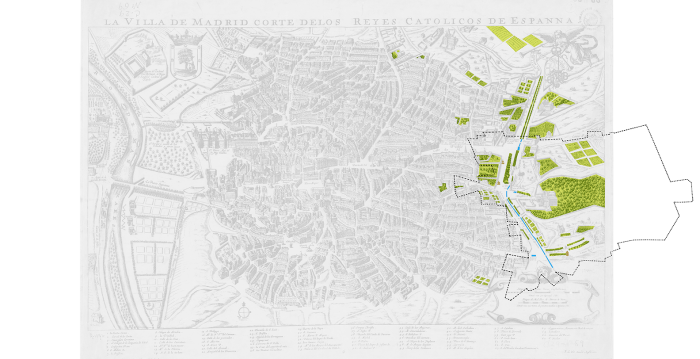
Map of the city of Madrid. Court of the Catholic Monarchs of Spain (1623), Antonio Mancelli. Travel network analysis, prepared by the authors based on historical cartography.

Map of the city of Madrid. Court of the Catholic Monarchs of Spain (1623), Antonio Mancelli. Travel network analysis, prepared by the authors based on historical cartography.

In this sense, a case of particular interest (if not, the most) is the area surrounding the Paseo del Prado and the Royal Site of Buen Retiro, now recognized as a World Heritage Site by UNESCO. This urban fragment underwent numerous transformations from its origins as a place of productive retreat to its consolidation as Madrid’s main urban scene, accumulating a large number of historical layers. Of all these layers, the deepest is, precisely, the water system that flowed underground, silently, connecting its main avenues, gardens, and buildings to enable both beauty and functionality.

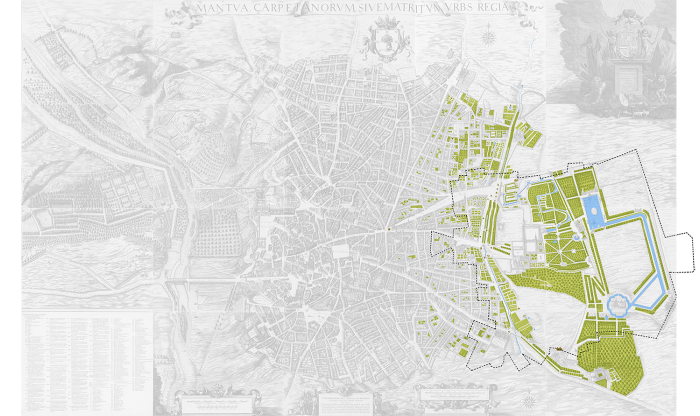
Topography of the City of Madrid (1656), by Pedro Texeira. National Geographic Institute. Analysis of the travel network, prepared by the authors based on historical cartography.

Topography of the City of Madrid (1656), by Pedro Texeira. National Geographic Institute. Analysis of the travel network, prepared by the authors based on historical cartography.

In this transformation process, the figure of the architect Juan de Villanueva would play a very significant role: while his architectural legacy has been widely recognized and studied from a purely monumental perspective, his participation in the planning and improvement of Madrid’s hydraulic infrastructure has received little attention. The truth is that, beginning in 1783, the architect assumed the inspection and renovation of the waterways around the Retiro Park, a responsibility that he carried out in parallel with the construction of his three major scientific projects for the Salón del Prado: the Royal Botanical Garden, the Cabinet of Natural History, and the Royal Astronomical Observatory. In this way, our current Paseo del Prado is the result of a comprehensive intervention between architecture and engineering that, far from acting autonomously, came together through a single urban project to achieve the materialization of a highly ambitious but no less complex idea.


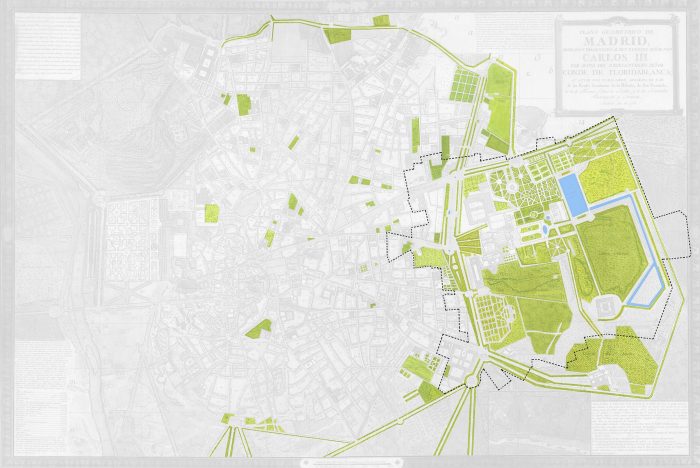
Map of the City of Madrid (1785), by Tomás López. Analysis of the travel network, prepared by the author based on historical cartography.

Map of the City of Madrid (1785), by Tomás López. Analysis of the travel network, prepared by the author based on historical cartography.

Villanueva’s intervention in the layout of these waterways and in their collection, conveyance, and distribution systems, as well as their connection with the urban complexity of 18th-century Madrid, also demonstrate the existence and mastery of a sophisticated hydraulic culture and infrastructure, revealing a much less iconic but equally decisive facet of his work and, above all, of his impact on the city.


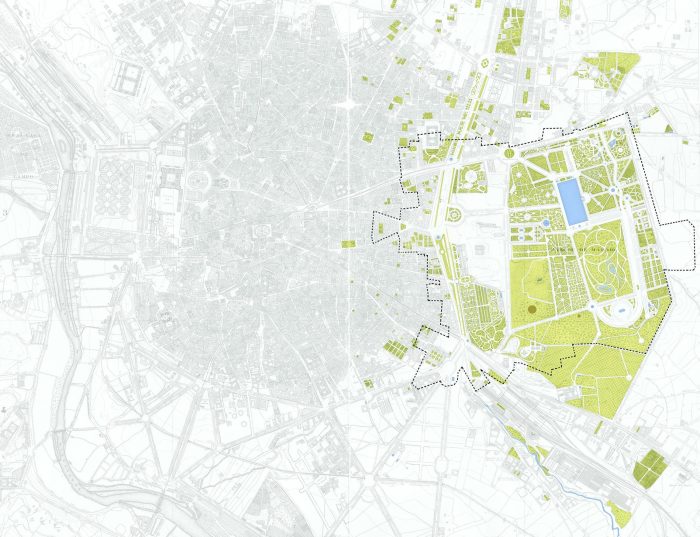
Land map of Madrid (1877), Carlos Ibáñez and Ibáñez de Íbero. Geographical and Statistical Institute. Travel network analysis, prepared by the authors based on historical cartography.

Land map of Madrid (1877), Carlos Ibáñez and Ibáñez de Íbero. Geographical and Statistical Institute. Travel network analysis, prepared by the authors based on historical cartography.

Today, Villanueva’s hydraulic legacy in the city of Madrid remains largely hidden, deteriorated, or in disuse. However, beyond the vindication of the historical interest of the underground structures that make up the waterway network, it is possible to engage in a contemporary reflection on its valorization through heritage recognition and reuse. Thus, in the face of the progressive deterioration of the system, confirmed by multiple recent technical reports, the possibility of its partial recovery as an educational urban resource, as a landscape element, or even as a sustainable strategy for water management arises. At this intersection of memory, technique, and design, waterway journeys occupy an indispensable place, on the one hand, in Villanueva’s work; and, above all, in the construction of Madrid’s urban identity.

Map of the city of Madrid. Court of the Catholic Monarchs of Spain (1623), Antonio Mancelli. Travel network analysis, prepared by the authors based on historical cartography.
Topography of the City of Madrid (1656), by Pedro Texeira. National Geographic Institute. Analysis of the travel network, prepared by the authors based on historical cartography.
Map of the City of Madrid (1785), by Tomás López. Analysis of the travel network, prepared by the author based on historical cartography.
Land map of Madrid (1877), Carlos Ibáñez and Ibáñez de Íbero. Geographical and Statistical Institute. Travel network analysis, prepared by the authors based on historical cartography.