Heritagescapes

We are mapping a heritage ecology of the metropolis of Madrid presented through theories, histories and designs.

A Critical Mapping of the Metropolitan Cultural Landscape: Future Heritages

Research project developed by the Cultural Landscape Research Group GIPC of the Madrid School of Architecture at the Universidad Politécnica de Madrid, with the participation of the ADAPTA Research Group at the Universidad Complutense de Madrid. 
Grant PID2022-140500NB-I00 funded by: 

The Frontline Around Madrid: Comparison Between Battle Maps and War Remnants Density Maps of the Spanish Civil War in Madrid

Nicolás Mariné

Curating Heritage. On the Future of the Past in the Everyday Landscape of the Metropolis of Madrid

Rodrigo de la O and Eduardo de Nó

Everyday heritage: Representation and landscape in the region of Madrid

David Escudero and Diego Toribio

Architecture and landscapes for agricultural research in Madrid: documenting scientific and technological heritage

Rodrigo de la O and Eduardo de Nó

Are We What We Eat? A Heritage Perspective on the Agri-food Landscapes of the Madrid Region

David Escudero, Beatriz Pereira

Water to Feed Madrid: 18 km of Orchards and Nurseries Along the Course of the Canalillo

Carmen Toribio

Gardens of yesterday and today, their persistence in the City of Madrid: Comparative study of the Transformation of Private Gardens in Madrid

Lucía Gamboa Sánchez Blanco

Vestige, Signal and Onset of an Event: Sundays at the Rastro

Marina Gil Escalada

Reclaiming the City Through Its River: The Case of the Manzanares

Claudia Rivera Lario

Domestic Architecture in the Sierra de Guadarrama: 20th Century

Guillermo García Prieto

Industrial Madrid: evolution and permanences Around Atocha

Marta Abadín García

Devices of the Real, Collective Devices

Carlo Udina Rodríguez

Between the Playful and the Working-Class: An Atlas of Goya’s Madrid

Juan Castro Sánchez

Towards a Master Plan for the Landscape of Light: Paseo del Prado and Buen Retiro, Landscape of Arts and Sciences

Pablo Jaque Valdés

From water to landscape: the transformation of the Royal Site of Aranjuez through Hydraulic Engineering

Carlos Corisa Andarias

From the kitchen to the landscape. Architectures of Cocido in Madrid.

Beatriz Pereira

Among productive landscapes: the former El Águila brewery in Villaverde, Madrid.

Diego Sacristán

Adaptive reuse and heritage practice: Origins, meanings and strategies

Graziella Trovato

Unveiling Madrid’s Visual Imagery: An Ongoing Attempt

David Escudero

Navigating the Meaques Stream in the Casa de Campo

Clara Cernou

The water footprints of enlightened Madrid and the hydraulic legacy of Juan de Villanueva

Eugenia Abejón

Transhumance Landscapes and Nature-Based Tourism

Cecilia Arnaiz and Marifé Schmitz

Castle of Villaviciosa de Odón: A Scientific Heritage of Forestry Research and Education

Eduardo de Nó

Heritage Networks in Villaverde’s Industrial Landscape

Rafael Guerrero

Ecology of the Royal Sites: The Livestock Trails of El Escorial

Eva Calderón

Co-Design in Urban Framing

Finca formativa "Huerto El Pozo"

The GIPC

Rethinking Public Spaces through Urban Farming

Concha Lapayese, Francisco Arques y Diego Martín-Sánchez

Unveiling Agricultural Heritage

Marina López-Sánchez

Historic Nurseries: A Cultural and Natural Legacy in Transformation

Carmen Toribio

Hydraulic Heterotopias: The Image of Technique

Carmen Toribio

Surrounding the Non-Urbanized Villa de Vallecas

Marina López-Sánchez

Curating Heritage Ecologies

Surrounding the Non-Urbanized Villa de Vallecas

MWP-I
MAPPING INFRASTRUCTURES AND
NATURECULTURE VALUES
Info

Marina López-Sánchez calls for deeming the territorial deep traces identified through 20th century maps.

Villa de Vallecas is now a popular district in the southeast of the municipality of Madrid, which has a deep metropolitan identity associated with the unbridled expansion of the 20th century. It used to be a small village very close to the city, which gradually became the welcoming place for thousands of families coming from the countryside all over Spain. It therefore occupies an important place in urban working-class culture.

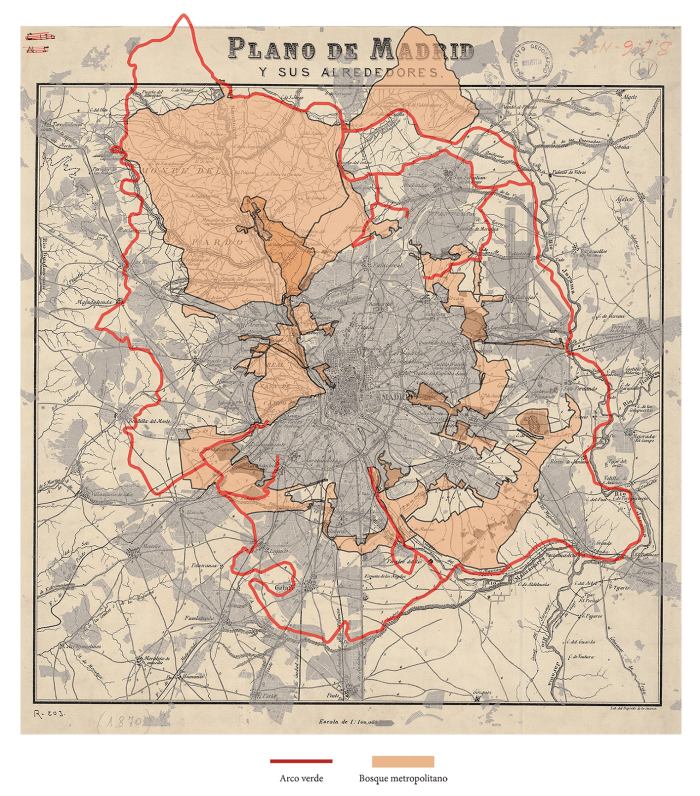
This is a superimposition of the current metropolitan area of Madrid on an old map of the city and its surroundings from 1890. This map was produced by Marina López in 2023.

This is a superimposition of the current metropolitan area of Madrid on an old map of the city and its surroundings from 1890. This map was produced by Marina López in 2023.

The district benefits from two new green infrastructure plans on the periphery of the municipality of Madrid: Arco Verde and Bosque Metropolitano. Both landscape projects propose new ways of acting to adapt to climate change and the urban heat island. Among their essential objectives are the protection of biodiversity through ecological corridors, the conservation of ecosystems and the reinforcement of ecological functions. In Vallecas, almost 60% of it is within the delimitation of the Bosque Metropolitano and almost all of its southwestern edge, which represents 35% of its total perimeter, runs along the Arco Verde.

However, despite the undoubted prominence of ecological restoration in green infrastructures, the success of these strategies depends on the integration of the environmental and socio-cultural dimensions. New projects must also be consistent with the cultural character of the landscape, which requires full consideration of historical and heritage values. In this framework, we present a methodology for recognising the material cultural features of the landscape, which in turn underpin immaterial expressions and processes.
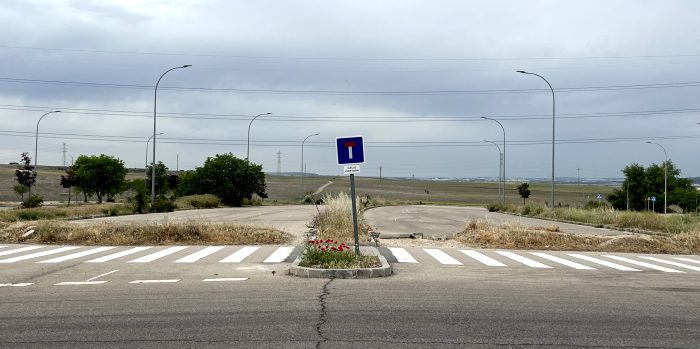
The district has undergone intense changes in the 21st century. Urban development operations representative of the real estate bubble in Spain can be found in this district and its surroundings, configuring semi-urbanised and semi-developed areas: El Cañaveral, Los Berrocales, and the Ensanche de Vallecas itself – oversized and still very incomplete -, or the unoccupied Atalayay industrial estate.

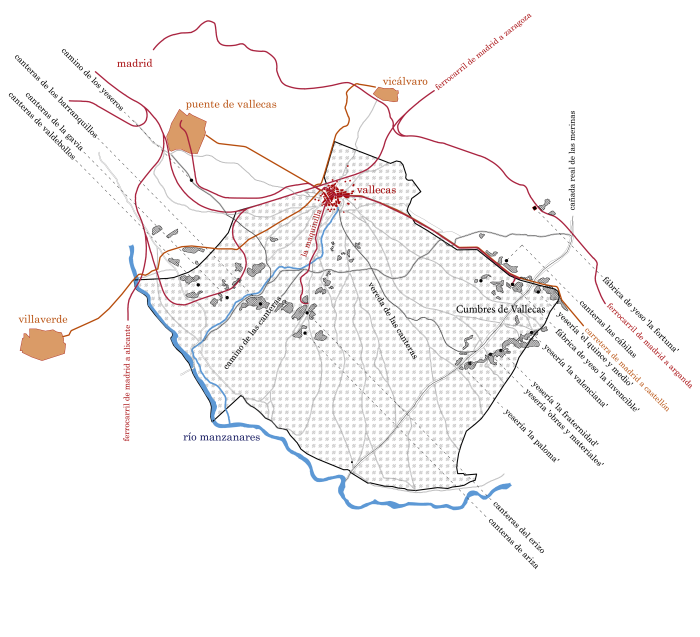
The territorial structure of the industrial plaster landscape in Vallecas during the first half of the 20th century. Map produced by Marina López, 2023.

The territorial structure of the industrial plaster landscape in Vallecas during the first half of the 20th century. Map produced by Marina López, 2023.

The study of the historical cartography of the twentieth century confirms that there has been a serious destruction of heritage, since there is practically no architectural heritage that today reveals the industrial past of this area. We also observe how significant heritage remains in the environment. Places such as Cerro Almodovar, of geological, archaeological, cultural and scenic interest, have been constrained. The linear heritage of the old agricultural roads has also not been considered, but its structural character in the territory has favored its permanence for a longer period of time, and even today we can recognize the original routes of some roads.

The analysis carried out has made it possible to underline the deep historical meaning of these roads and to recognize their value beyond the route itself, but also that of the places they pass through and the original reasons for the journeys. These roads today make up a specific type of territorial heritage that, due to their important ecological, cultural and landscape value, constitutes today a relevant opportunity for the district of Vallecas because, although damaged, we know that the roads had as their original reason the connection between the town and the Manzanares River, today restored as an important fluvial park.

The Gran Vía del Sureste avenue is abruptly interrupted at its intersection with the Val de la Culebra road in the Vallecas expansion area. Photograph by Marina López, 2023.

The Gran Vía del Sureste avenue is abruptly interrupted at its intersection with the Val de la Culebra road in the Vallecas expansion area. Photograph by Marina López, 2023.

Read the full article:

López Sánchez, M. (2024). Patrimonio territorial en el sureste de Madrid: un análisis a través de la cartografía histórica del siglo XX. ACE: Architecture, City and Environment, 18(54), 12373. https://doi.org/10.5821/ace.18.54.12373

This is a superimposition of the current metropolitan area of Madrid on an old map of the city and its surroundings from 1890. This map was produced by Marina López in 2023.
The territorial structure of the industrial plaster landscape in Vallecas during the first half of the 20th century. Map produced by Marina López, 2023.
The Gran Vía del Sureste avenue is abruptly interrupted at its intersection with the Val de la Culebra road in the Vallecas expansion area. Photograph by Marina López, 2023.