We are mapping a heritage ecology of the metropolis of Madrid presented through theories, histories and designs.
No European metropolis can be planned through binary theories that separates city from countryside, culture from nature, past from future. The perspective of ecology has overcome these unproductive divisions and open the territorial design agenda to new questions. Metropolises are now complex urban-rural gradients endowed with multifunctional landscapes with truly hybrid natural-cultural values. These values emerge in the ecological interconnection of environmental, social and economic trends. In this context, we believe that heritage can be a partner for ecologising our territory in a new metropolitan agenda. To look at this opportunity, we are mapping the Metropolitan Region of Madrid, the ensemble of its everyday landscapes, as well as its unique and degraded landscapes. Using large spatial databases and our own fieldwork in three mapping work packages (MWP), critical mapping allows us to represent theories, histories and designs in an interconnected heritage ecology. At the same time, we will expand the discussion with colleagues researching other European metropolises.
MAPPING INFRASTRUCTURES AND NATURECULTURE VALUES
Conceived as territorial supply and regulation networks, metropolitan infrastructures hide histories. Infrastructure is originally planned and designed, but its current form is often the result of aggregations over time – it needs repairs, extensions or partial replacements, and is rarely completely replaced. Infrastructures often leave spatial traces that explain the functions and shape of our landscapes. Therefore, green, blue or transport infrastructures can become a heritage ecology that project the past into the present and the future. We believe that the natural-cultural values of infrastructures can help us to understand the complexity of our metropolitan landscape, as well as to achieve future quality landscapes.
MAPPING CULTURAL ASSETS AND PROTECTED LANDSCAPES
While natural heritage policies often exclude a real attention to cultural features, cultural heritage policies dismiss nature. Both have led to a spatial configuration of protected and seeming isolated patches. But on the one hand, the landscape of natural parks is the result of traditional human use of resources. On the other hand, historic sites had a strong sense of place and became fundamental patches of territorial structuring in an environmental sense. Based on ecological theories of heritage, we believe that protected patches contribute more to the quality of life if we can integrate them into heritage territorial systems. To this end, new imaginaries of conservation must be envisioned.
MAPPING AGROECOLOGY AND SUPPLY CHANNELS
In our metropolitan territory, a concentric urban-rural gradient is crossed by a geographical gradient that goes from the Sierra de Guadarrama in the northwest to the plain of the Tagus River in the southeast. Here, agricultural draws diversified and sometimes rare patterns. Farming intermingles with the villages and modern urbanization further away from the capital, but also tries to penetrate the capital itself. Moreover, agriculture is present in historical places and is sometimes related to our scientific and technological heritage. We understand agriculture as a vector of patrimonialisation and social and environmental innovation, capable of providing new forms of public spaces and landscapes.
Research team:
Estudio Paisaje is a teaching experience that arises as a tool for dialogue with the context of the climate and eco-social crisis that we live in. This “studio”, taught in the subject of Architectural Projects at the ETSAM UPM, is presented as a pedagogical approach that seeks to expand the scope of the discipline and its operational methodologies, with the aim of providing students with tools to co-design spaces and territories, implement multi-scale strategies and form networks of more-than-human agents around urban agroecology. This transfer of knowledge is explored in a double aspect: on the one hand, between research and teaching, developed in collaboration with the Cultural Landscape Research Group (GIPC) and the project of the State Plan for I+D+i, HERITAGESCAPES: Critical cartography of the metropolitan cultural landscape; and on the other hand, the transfer between teaching and society through a Learning and Service (ApS) project that brought together different social and institutional agents.
«Where am I? Describing a territory, but on site. Where can we find the border that separates what is natural from what is not? Does such a border exist? What separates what we call natural from what we call cultural or human? Culture and nature: there is no way to escape this moral opposition; they are an inseparable couple that seems to distinguish what is good from what is bad.»
Bruno Latour
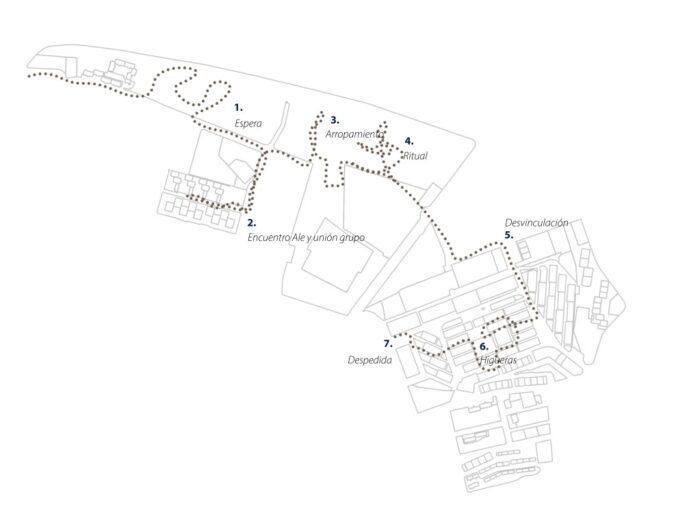
Cartography prepared by the students of the subjects Landscape Study and Experimental Workshop: Hybrid Actions in the Landscape during the 2023-2024 academic year.
The relevance of reflecting on the “landscape” as a design strategy comes from the need for students to be aware of the territory where the architecture is assembled. To this end, this communication seeks to understand the landscape as an active and generative element of the architectural proposal from a dual teaching and research perspective. A reality that is interpreted by the European Landscape Convention (2000), from a new perspective of territorial development, which highlights and reveals the aspects implicit in the landscape: cultural, environmental and political.
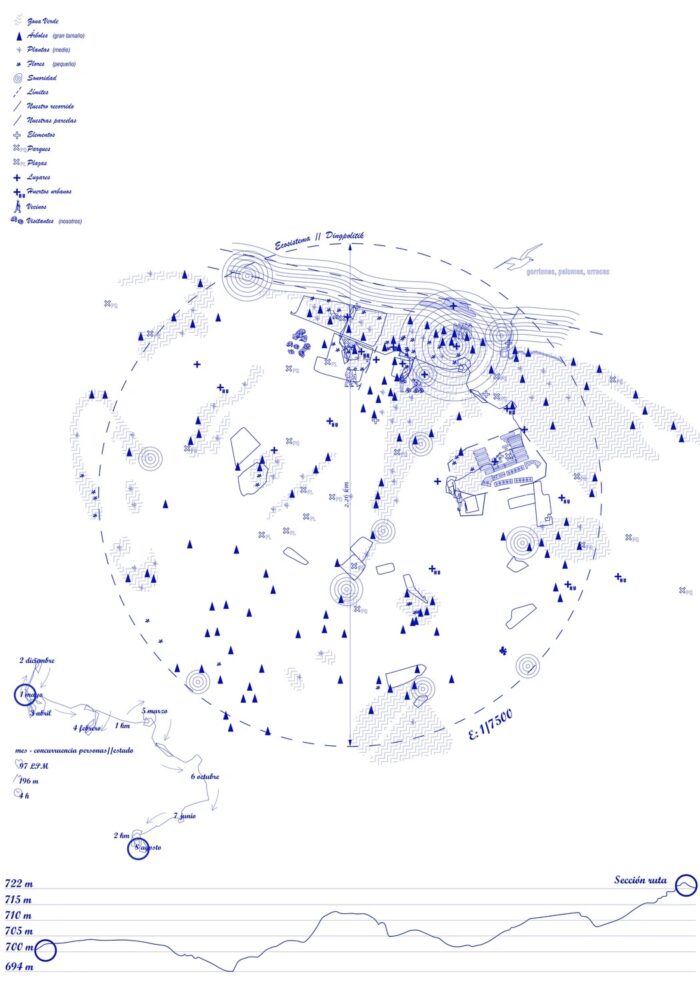
Cartography prepared by the students of the subjects Landscape Study and Experimental Workshop: Hybrid Actions in the Landscape during the 2023-2024 academic year.
Estudio Paisaje proposes to broaden the usual scope of teaching in projects, linking the course to ongoing research, and transcending the physical limits of the classroom through dialogue with the agents involved. In the spring semester of the 2023-24 academic year, the subject Estudio Paisaje, from the Department of Architectural Projects at ETSAM, focused its research on this municipal strategy. The teaching staff and students of two other subjects also participated: Landscape and Garden, from the Department of Architectural Composition; and Experimental Workshop on Hybrid Actions, from the Department of Architectural Projects. The objective has been to link students with an eco-social and environmental cooperation activity that is being developed in the city of Madrid.
The objective of the ApS project is twofold: on the one hand, it seeks to support the Tangente group in the task of mapping the network of actors, as well as the resources that make it up; and on the other hand, to make design proposals for future productive settlements of the Barrios Productores program. In this second task, the Madrid City Council itself is involved, with the selection of those underused spaces that can be transformed into new urban ecosystems. The «learning and service» project that we present is in itself a potential pedagogical project in which we establish the design process from three work phases: analytical, conceptual and projective.
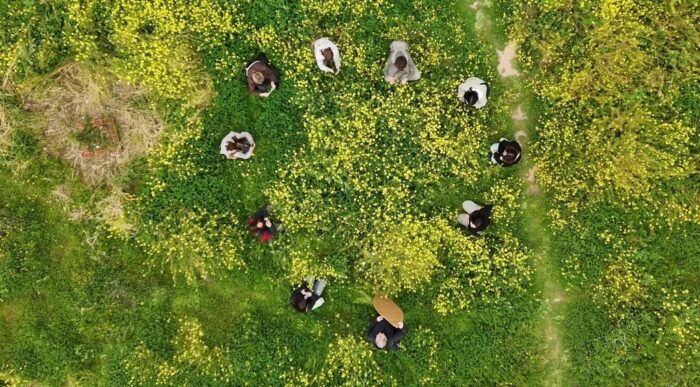
Photograph taken by the students of the subjects Landscape Study and Experimental Workshop: Hybrid Actions in the Landscape during the 2023-2024 academic year.
Throughout the course, learning objectives have been achieved that have allowed the students to develop various skills. In the academic field, they have demonstrated their ability to create architectural projects that meet aesthetic and technical requirements, in addition to having analyzed contemporary challenges related to green infrastructure, the cultural landscape, agroecology and urban agriculture. As for personal skills, they have strengthened their ability to make judgments about the economic, social and environmental implications of their decisions, managing information efficiently and providing creative solutions to specific problems. Finally, in the social sphere, they have deepened their role as future architecture professionals in society, developing projects that consider social factors and participating in interdisciplinary collective entrepreneurship initiatives, which has allowed them to become aware of the importance of their profession in the current context.