We are mapping a heritage ecology of the metropolis of Madrid presented through theories, histories and designs.
No European metropolis can be planned through binary theories that separates city from countryside, culture from nature, past from future. The perspective of ecology has overcome these unproductive divisions and open the territorial design agenda to new questions. Metropolises are now complex urban-rural gradients endowed with multifunctional landscapes with truly hybrid natural-cultural values. These values emerge in the ecological interconnection of environmental, social and economic trends. In this context, we believe that heritage can be a partner for ecologising our territory in a new metropolitan agenda. To look at this opportunity, we are mapping the Metropolitan Region of Madrid, the ensemble of its everyday landscapes, as well as its unique and degraded landscapes. Using large spatial databases and our own fieldwork in three mapping work packages (MWP), critical mapping allows us to represent theories, histories and designs in an interconnected heritage ecology. At the same time, we will expand the discussion with colleagues researching other European metropolises.
MAPPING INFRASTRUCTURES AND NATURECULTURE VALUES
Conceived as territorial supply and regulation networks, metropolitan infrastructures hide histories. Infrastructure is originally planned and designed, but its current form is often the result of aggregations over time – it needs repairs, extensions or partial replacements, and is rarely completely replaced. Infrastructures often leave spatial traces that explain the functions and shape of our landscapes. Therefore, green, blue or transport infrastructures can become a heritage ecology that project the past into the present and the future. We believe that the natural-cultural values of infrastructures can help us to understand the complexity of our metropolitan landscape, as well as to achieve future quality landscapes.
MAPPING CULTURAL ASSETS AND PROTECTED LANDSCAPES
While natural heritage policies often exclude a real attention to cultural features, cultural heritage policies dismiss nature. Both have led to a spatial configuration of protected and seeming isolated patches. But on the one hand, the landscape of natural parks is the result of traditional human use of resources. On the other hand, historic sites had a strong sense of place and became fundamental patches of territorial structuring in an environmental sense. Based on ecological theories of heritage, we believe that protected patches contribute more to the quality of life if we can integrate them into heritage territorial systems. To this end, new imaginaries of conservation must be envisioned.
MAPPING AGROECOLOGY AND SUPPLY CHANNELS
In our metropolitan territory, a concentric urban-rural gradient is crossed by a geographical gradient that goes from the Sierra de Guadarrama in the northwest to the plain of the Tagus River in the southeast. Here, agricultural draws diversified and sometimes rare patterns. Farming intermingles with the villages and modern urbanization further away from the capital, but also tries to penetrate the capital itself. Moreover, agriculture is present in historical places and is sometimes related to our scientific and technological heritage. We understand agriculture as a vector of patrimonialisation and social and environmental innovation, capable of providing new forms of public spaces and landscapes.
Research team:
Cities have always been imaged by art, carrying with them a multiplicity of artistic representations of their built space seamlessly incorporated into their visual repertoire. Madrid is no exception: photographs, poems, novels, posters, cartoons, films—even music—have collectively contributed to shaping a rich and intangible urban tapestry, one where the city is not only lived, but also envisioned. As a form of creation and repository of collective images, this imaginary of Madrid is thus a product of social space and therefore arises from a process of negotiation between the environment and the built space mediated through art.
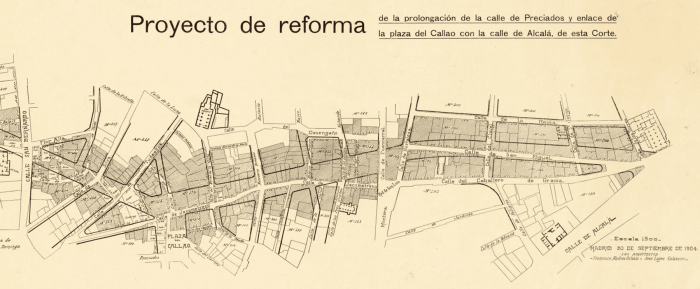
Gran Vía master plan, Francisco Andrés Octavio and José López Sallaberry, 1904.
Just as striking is the recurrent use of the city’s periphery, an undeveloped space whose significance quickly grew following the rural exodus of the 1940s. It was precisely this evolving landscape that directors like Luis García Berlanga, Carlos Saura and Pedro Almodóvar turned their lens toward, depicting the life in those suburbs that neither Metro nor money will ever arrive to. In this sense, by analyzing the physical conditions and the characterization of the space represented, we can approach how each scene, in its own way, triggers an irreversible action on the space in which it is set: it charges it up with images of meaning.
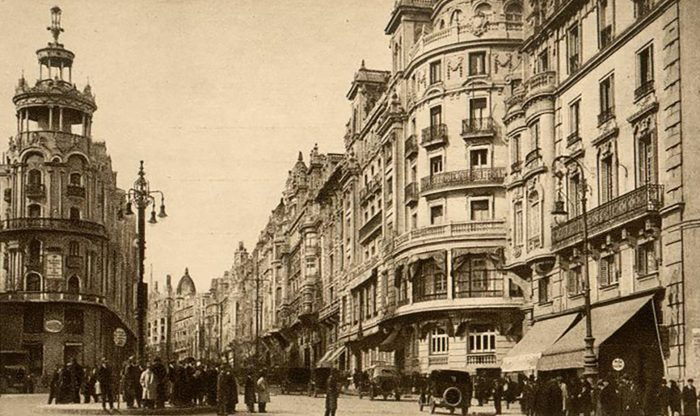
Postcard from the crossing between C/ Alcalá and Gran Vía, author unknown, c. 1925.
Cinema, in particular, reveals layers of the city that might otherwise remain unseen. It is no longer the space or the scene that matter separately, but rather the scene in the space, and the space as touched by the projected image. By mapping over one hundred film scenes onto a digital cartography of Madrid, we are able to distinguish some areas that have been heavily imbued with qualities through filmmaking. Unsurprisingly, the historic city centre emerges as a prominent node. Films such as El día de la bestia (Álex de la Iglesia, 1995), El último caballo (Edgar Neville, 1950), Abre los ojos (Alejandro Amenábar, 1997), or Laberinto de pasiones (Pedro Almodóvar, 1982), among many others, took advantage of its historical significance and incorporated it into their production.
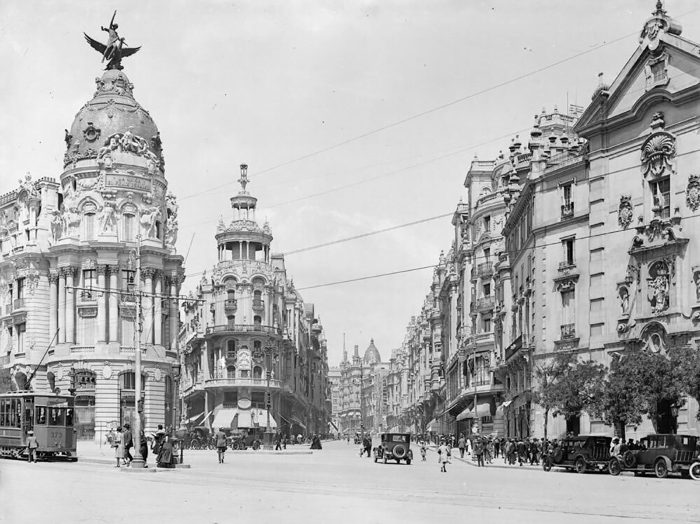
Photograph of the Gran Vía, attributed to Otto Wunderlich, c. 1925.
When multiple scenes coincide in or near the same location, this layering produces a powerful accumulation of imagery. Such is the case with the Gran Vía. Conceived at the turn of the twentieth century as a herald of modernity, the Gran Vía has served as both subject and backdrop for a wide spectrum of artistic forms. A photograph by Otto Wunderlich taken around 1925, and a postcard produced just months later, stand among the earliest visual records of the street from its intersection with Calle Alcalá.
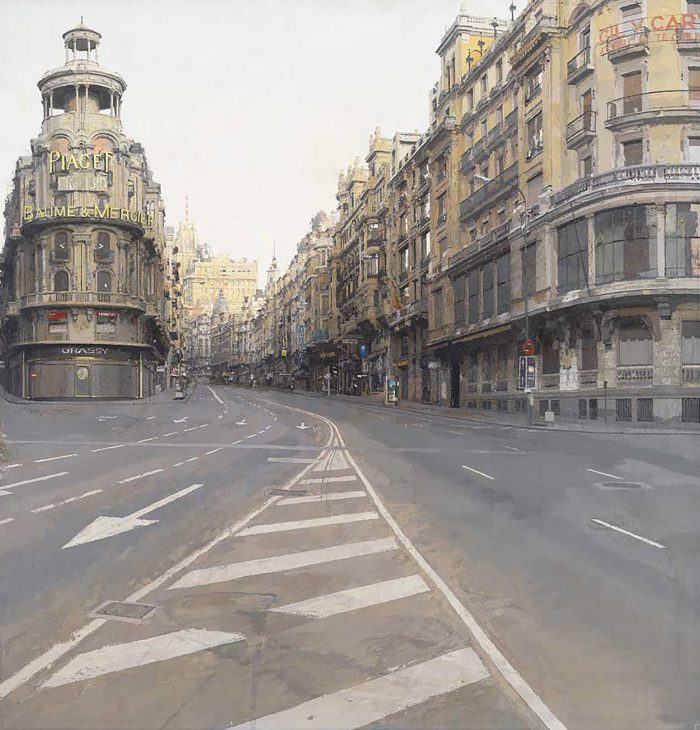
Gran Vía de Madrid, Antonio López, 1974-1985.
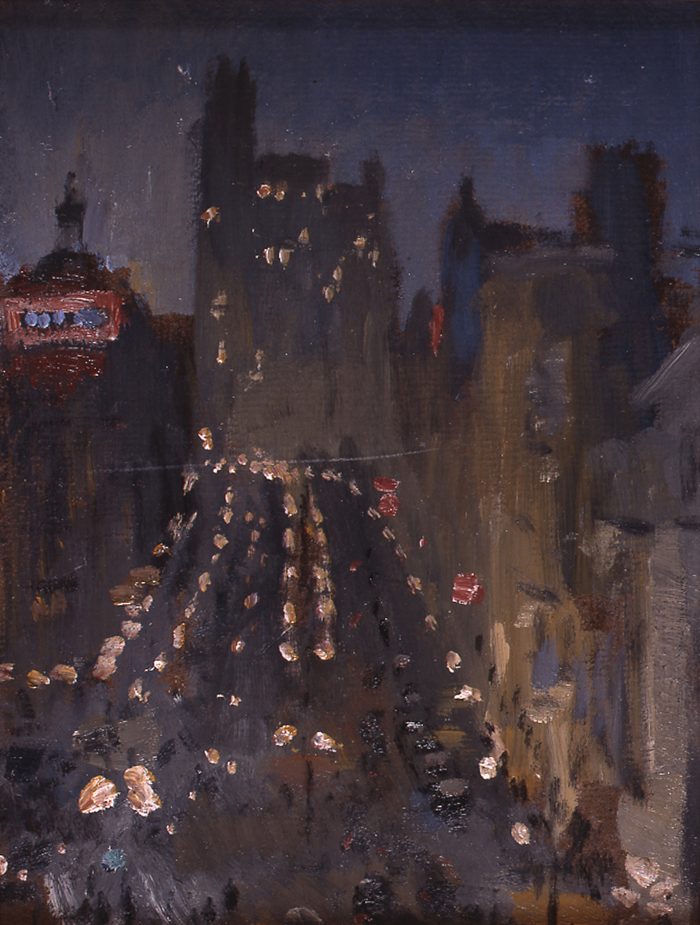
Both capture a newly inaugurated artery, teeming with life and optimism. That same stretch would later be reimagined by painters like Nicanor Piñole in the 1930s and Antonio López between 1974 and 1981. There are fifty years of distance between the works of these two artists, but there is also an important distance in the aura of the iconic space represented: the light of opposite moments of the day; the indeterminate and grey human masses against the impossible emptiness of a street that never is; or the atmosphere of an incipient modern city that shortly after would be the scene of the Spanish Civil War against that of one that was emerging exhausted from almost forty years of dictatorship. In this representing the place, is it not true that they fix the identity of the community as much as that of the place?
La Gran Vía, Nicanor Piñole. circa 1935. Museo Nicanor Piñole, Gijón.
Above all, these images of Madrid help to strengthen the inhabitants’ sense of identity, foster social engagement, and deepen their feeling of belonging—ultimately cementing the powerful bond between people and place, and bearing witness to a shared urban life. Revealing the connections between communities, the spaces they inhabit, and the imagery that represents them shows how such representations are not mere reflections, but fundamental threads in the fabric of collective memory—and therefore, of cultural heritage. As Antonio Flores sang in 1988 in his iconic song Gran Vía:
«Pies acostumbrados a la velocidad
Personas que viven a un ritmo infernal
[…]
Oh, Gran Vía, y llevas aquí casi toda la vida
Oh, Gran Vía, la gente te quiere, todavía.»
(«Feet that have grown used to speed,
People living their lives at a hellish pace.
[…]
Oh, Gran Vía, you’ve been here almost forever,
Oh, Gran Vía, people love you, still».)