We are mapping a heritage ecology of the metropolis of Madrid presented through theories, histories and designs.
A Critical Mapping of the Metropolitan Cultural Landscape: Future Heritages
Heritagescapes
No European metropolis can be planned through binary theories that separates city from countryside, culture from nature, past from future. The perspective of ecology has overcome these unproductive divisions and open the territorial design agenda to new questions. Metropolises are now complex urban-rural gradients endowed with multifunctional landscapes with truly hybrid natural-cultural values. These values emerge in the ecological interconnection of environmental, social and economic trends. In this context, we believe that heritage can be a partner for ecologising our territory in a new metropolitan agenda. To look at this opportunity, we are mapping the Metropolitan Region of Madrid, the ensemble of its everyday landscapes, as well as its unique and degraded landscapes. Using large spatial databases and our own fieldwork in three mapping work packages (MWP), critical mapping allows us to represent theories, histories and designs in an interconnected heritage ecology. At the same time, we will expand the discussion with colleagues researching other European metropolises.
MWP-I
MAPPING INFRASTRUCTURES AND NATURECULTURE VALUES
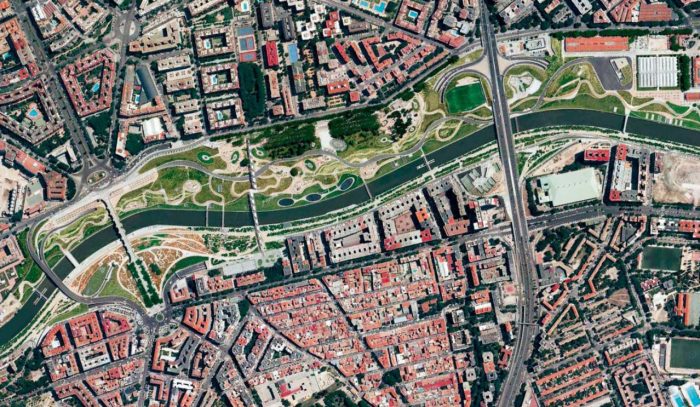
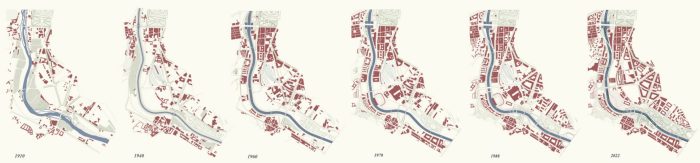
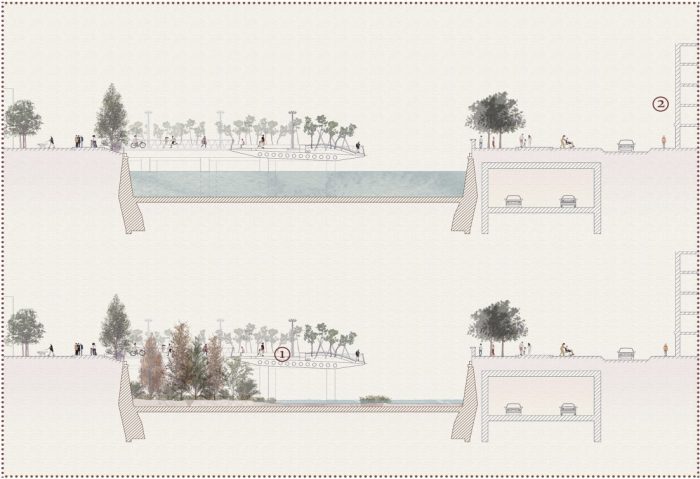
Conceived as territorial supply and regulation networks, metropolitan infrastructures hide histories. Infrastructure is originally planned and designed, but its current form is often the result of aggregations over time – it needs repairs, extensions or partial replacements, and is rarely completely replaced. Infrastructures often leave spatial traces that explain the functions and shape of our landscapes. Therefore, green, blue or transport infrastructures can become a heritage ecology that project the past into the present and the future. We believe that the natural-cultural values of infrastructures can help us to understand the complexity of our metropolitan landscape, as well as to achieve future quality landscapes.
MWP-II
MAPPING CULTURAL ASSETS AND PROTECTED LANDSCAPES
While natural heritage policies often exclude a real attention to cultural features, cultural heritage policies dismiss nature. Both have led to a spatial configuration of protected and seeming isolated patches. But on the one hand, the landscape of natural parks is the result of traditional human use of resources. On the other hand, historic sites had a strong sense of place and became fundamental patches of territorial structuring in an environmental sense. Based on ecological theories of heritage, we believe that protected patches contribute more to the quality of life if we can integrate them into heritage territorial systems. To this end, new imaginaries of conservation must be envisioned.
MWP-III
MAPPING AGROECOLOGY AND SUPPLY CHANNELS
In our metropolitan territory, a concentric urban-rural gradient is crossed by a geographical gradient that goes from the Sierra de Guadarrama in the northwest to the plain of the Tagus River in the southeast. Here, agricultural draws diversified and sometimes rare patterns. Farming intermingles with the villages and modern urbanization further away from the capital, but also tries to penetrate the capital itself. Moreover, agriculture is present in historical places and is sometimes related to our scientific and technological heritage. We understand agriculture as a vector of patrimonialisation and social and environmental innovation, capable of providing new forms of public spaces and landscapes.
Research project developed by the Cultural Landscape Research Group GIPC of the Madrid School of Architecture at the Universidad Politécnica de Madrid, with the participation of the ADAPTA Research Group at the Universidad Complutense de Madrid.

Grant PID2022-140500NB-I00 funded by:

Research team: