We are mapping a heritage ecology of the metropolis of Madrid presented through theories, histories and designs.
No European metropolis can be planned through binary theories that separates city from countryside, culture from nature, past from future. The perspective of ecology has overcome these unproductive divisions and open the territorial design agenda to new questions. Metropolises are now complex urban-rural gradients endowed with multifunctional landscapes with truly hybrid natural-cultural values. These values emerge in the ecological interconnection of environmental, social and economic trends. In this context, we believe that heritage can be a partner for ecologising our territory in a new metropolitan agenda. To look at this opportunity, we are mapping the Metropolitan Region of Madrid, the ensemble of its everyday landscapes, as well as its unique and degraded landscapes. Using large spatial databases and our own fieldwork in three mapping work packages (MWP), critical mapping allows us to represent theories, histories and designs in an interconnected heritage ecology. At the same time, we will expand the discussion with colleagues researching other European metropolises.
MAPPING INFRASTRUCTURES AND NATURECULTURE VALUES
Conceived as territorial supply and regulation networks, metropolitan infrastructures hide histories. Infrastructure is originally planned and designed, but its current form is often the result of aggregations over time – it needs repairs, extensions or partial replacements, and is rarely completely replaced. Infrastructures often leave spatial traces that explain the functions and shape of our landscapes. Therefore, green, blue or transport infrastructures can become a heritage ecology that project the past into the present and the future. We believe that the natural-cultural values of infrastructures can help us to understand the complexity of our metropolitan landscape, as well as to achieve future quality landscapes.
MAPPING CULTURAL ASSETS AND PROTECTED LANDSCAPES
While natural heritage policies often exclude a real attention to cultural features, cultural heritage policies dismiss nature. Both have led to a spatial configuration of protected and seeming isolated patches. But on the one hand, the landscape of natural parks is the result of traditional human use of resources. On the other hand, historic sites had a strong sense of place and became fundamental patches of territorial structuring in an environmental sense. Based on ecological theories of heritage, we believe that protected patches contribute more to the quality of life if we can integrate them into heritage territorial systems. To this end, new imaginaries of conservation must be envisioned.
MAPPING AGROECOLOGY AND SUPPLY CHANNELS
In our metropolitan territory, a concentric urban-rural gradient is crossed by a geographical gradient that goes from the Sierra de Guadarrama in the northwest to the plain of the Tagus River in the southeast. Here, agricultural draws diversified and sometimes rare patterns. Farming intermingles with the villages and modern urbanization further away from the capital, but also tries to penetrate the capital itself. Moreover, agriculture is present in historical places and is sometimes related to our scientific and technological heritage. We understand agriculture as a vector of patrimonialisation and social and environmental innovation, capable of providing new forms of public spaces and landscapes.
Research team:
LANDSCAPE AND REPRESENTATION: ECHOES OF MEMORY AND FUTURE RECOLLECTIONS
SEMINAR
From September 30 to October 2, 2025
Auditorium of the Ministry of Culture
Twenty-five years after the adoption of the European Landscape Convention, this seminar addresses the challenges of conserving Spanish cultural landscapes from the perspective of their artistic representations. Starting from the premise that novels, paintings, photographs, films, and all other forms of expression shape imaginaries that influence collective memory and the emotional connection to places, the session proposes a critical review of the role of images in the construction, transformation, and valuation of the landscape.
The seminar, entitled «Landscape and Representation: Echoes of Memory and Remembrances Yet to Come,» offered a critical examination of the role of representation in fostering an emotional bond between communities and their landscapes. Coinciding with the 25th anniversary of the European Landscape Convention (2000), the event addressed the major challenges involved in conserving Spanish landscapes. It focused on how artistic representations in novels, paintings, films, and poems shape collective memory and construct a shared imagination. The seminar aimed to deepen understanding of landscapes by emphasizing the intersection of their territorial reality and the aesthetic layers they acquire. This approach seeks to improve conservation and safeguarding processes within the framework of the National Cultural Landscape Plan. Key themes included the specific contributions of photography and cinema to the construction of imaginaries and the capacity of representation to elevate landscapes to the status of cultural assets.
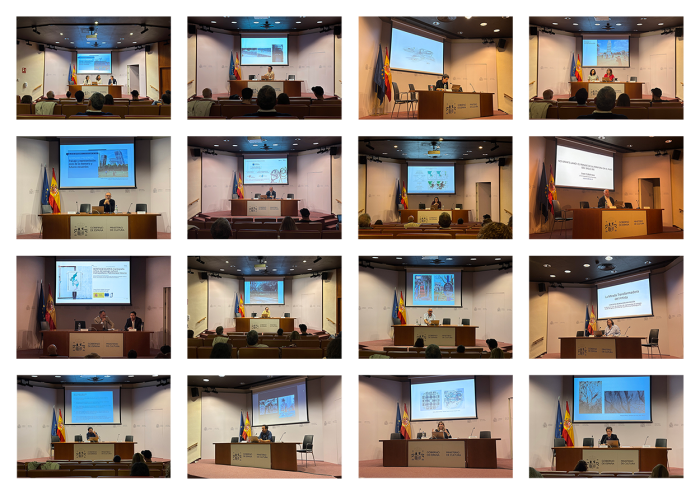
Matrix of photographs of the speakers who participated in the seminar during the presentation days, held in the Jorge Semprún Auditorium, Madrid.
The seminar took place over three days, and the presentations were organised around three main themes: urban space, suburbs, and rural areas. The first theme, dedicated to urban space, was developed during the first day. Opening this block, Guillermo Enríquez de Salamanca emphasized the use of photography as a tool for observing social heritage, discussing the active roles of both the viewer and the object in cultural construction. After him, Lucía Jalón Oyarzun argued for a form of collective mapping, a representation based on emotion rather than mimicking the environment. Beatriz Martins and Yolanda Riquelme (the collective “La Liminal”) presented their perspective on walking as an architectural practice that activates territory. Walking through Madrid brings the landscape to life as the body inhabits the urban space. Elías León Siminiani tackled the role of cinema in architectural narratives while demonstrating how the built environment can be expressive and meaningful by evoking memory through audiovisual work. Finally, Eduardo Miguel de Mesa picked up the cinematic thread to share the achievements of the “Enseñas Patrimonio” programme, in which the community participates in creating audiovisual pieces that speak to their memory. Those who shape the landscape also help to represent, translate, and communicate it.
The second block of presentations, dedicated to the suburbs, took place between the first and second day. Carlota Saénz de Tejada was the first to speak. In her presentation, she explored a perceptual approach to the periphery as a method for characterising it across different scales. She was followed by Juan Calatrava, who used 19th-century Paris as an example to highlight the richness of the periphery as a frontier territory. David Rejano and David Escudero led a discussion guided by images of Madrid’s periphery, where no distinction was made between the everyday and the extraordinary. The following day, Eduardo Nave drew on his photographic work to explain his approach to the landscape through the camera, while Marta Javierre and Fernando Gatón (Huesca Sonora) did the same through the sound recordings they produce in their processes of listening to the territory. Pedro Mullor closed the second block with a story about Kodak and the process of domesticating the photographic event.
The second day concluded with the third block, centred on rural areas. Adolfo Falces conveyed the value of the artist’s transformative gaze, using the CREATECH project to advocate for heritage education. Luis Costa spoke about the need to establish dialogues and relationships between rural landscapes, defending the aesthetic potential of any territory. Fernando García-Dory’s contribution addressed, in part, the possibility of reinventing the countryside through cultural representation. Esperanza Marrodán offered a reading of the landscape’s meaningful value, shaped by the gaze and laden with symbols that help us understand the world. The conference series concluded with Alba Campo Rosillo, who presented a reflective analysis of the colonial gaze in the construction and perception of landscapes. On the third and final day, the seminar concluded with a walking tour on “Paisaje de la Luz: World Heritage and Graphic Representation in Situ.”
Matrix of photographs from the guided interpretive visit made during the last day of the seminar to the Paisaje de la Luz Cultural Landscape, in Madrid.
The seminar was organized by the Institute of Cultural Heritage of Spain (IPCE) and was supported by the HERITAGESCAPES State R&D&I Project: “Critical Cartography of the Metropolitan Cultural Landscape: Future Heritage” (PID2022-140500NB-100). Scientific coordination was led by David Escudero (GIPC, Universidad Politécnica de Madrid) and David Rejano Peña (Madrid City Council).