Heritagescapes

We are mapping a heritage ecology of the metropolis of Madrid presented through theories, histories and designs.

A Critical Mapping of the Metropolitan Cultural Landscape: Future Heritages

Research project developed by the Cultural Landscape Research Group GIPC of the Madrid School of Architecture at the Universidad Politécnica de Madrid, with the participation of the ADAPTA Research Group at the Universidad Complutense de Madrid. 
Grant PID2022-140500NB-I00 funded by: 
A meeting dedicated to exploring the historical, spatial and social dimension of agroecology in the Madrid metropolis and to discussing the territorial and programmatic impact of initiatives such as Barrios Productores, among others.
A seminar on the role of artistic representations in the construction of landscape imaginaries and their impact on memory, identity and conservation processes.
A blended intensive programme (BIP, Erasmus+) conceived around the critical mapping of heritage practices in open public spaces.

Living Landscapes In Madrid

Blended Intensive Program (BIP, Erasmus+)

Madrid School of Architecture ETSAM

20-24 October 2025


IN PARTNERSHIP WITH:

Goethe-Universität Frankfurt (GE)

Instituto Universitário de Lisboa (PT)

Politecnico di Milano (IT)


IN COLABORATION WITH:

Ministry of Housing and Urban Agenda (MIVAU)

La Casa de la Arquitectura (LCA)

Madrid City Council (Ayuntamiento de Madrid)

Madrid Institute of Architects (COAM)


The conceptualization of this international workshop revolved around the critical mapping of heritage practices in open public spaces, seeking to dissolve the conventional separation between urban and rural in the contemporary metropolis, thus embracing its complexities and contradictions to imagine possible futures.


The audiovisual production resulting from the activity was included in the exhibition «Solastalgia: Walks through changing landscapes» (October 9, 2025 – February 15, 2026) at the MGGU – Museum Giersch der Goethe-Universität.

Living Landscapes in Madrid is part of a line of research that critically explores the transformations of the metropolitan cultural landscape from interdisciplinary perspectives. As an extension of previous BIPs dedicated to housing and spatial practices in Lisbon and Frankfurt, this edition focuses on the urban landscape as an area where historical, ecological, social and aesthetic dynamics converge. Its main objective is to problematise contemporary ways of inhabiting and representing public space, analysing the tensions between nature and culture, heritage and transformation, infrastructure and ecology, as well as the new forms of beauty that emerge in complex metropolitan contexts.

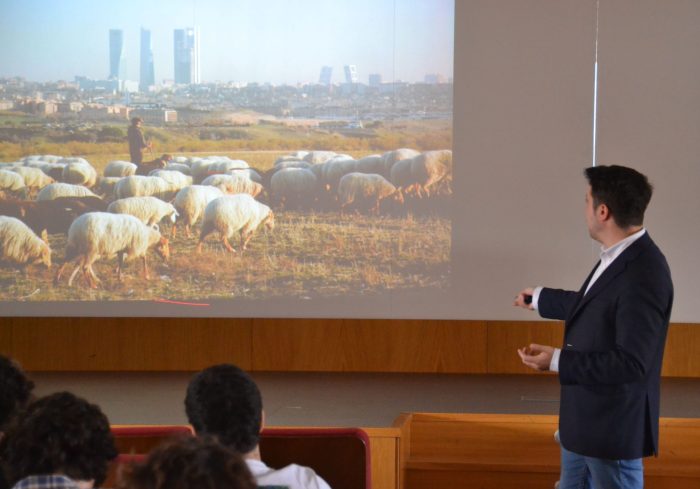
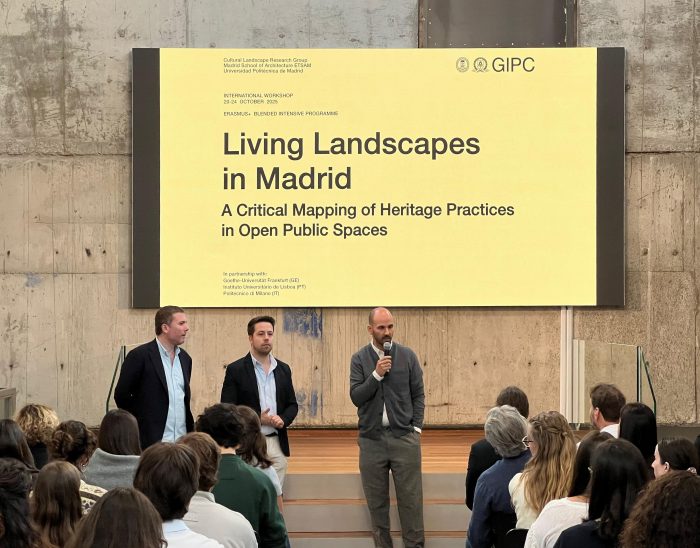
Presentation of the workshop main goals in the Conference Room of the Madrid School of Architecture ETSAM.

Presentation of the workshop main goals in the Conference Room of the Madrid School of Architecture ETSAM.

The experience of the previous BIPs had allowed for the consolidation of a pedagogical project focused on the question of dwelling. The role of architects as critical protagonists in debates on social housing had been the focus of Living in Lisbon, while in Spatial Practices and Housing in Frankfurt the debate had been extended to the scale of the city. In Living Landscapes in Madrid, attention was directed towards public space and urban landscapes, offering a critical perspective on the natural-cultural heritage practices in open public spaces within the metropolis.

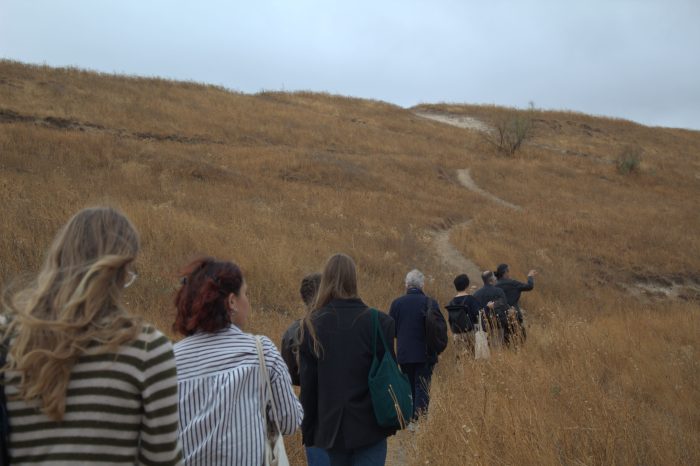
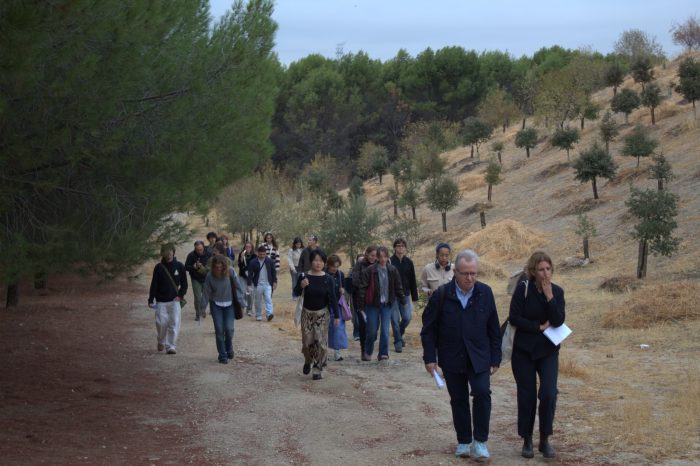
Guided tour and fieldwork in Cerro Almodóvar, one of the five case studies selected for the workshop, in the outskirts of the city.

Guided tour and fieldwork in Cerro Almodóvar, one of the five case studies selected for the workshop, in the outskirts of the city.

The workshop starts from the observation that today’s metropolises can no longer be understood in terms of classic dichotomies—urban/rural, natural/cultural, tangible/intangible—since these boundaries are blurred at the edges and peripheries of cities. Through the notion of ‘living landscapes,’ a relational reading of the territory is proposed in which historical processes, civic practices, agroecological dynamics, and diverse cultural imaginaries overlap. This approach coincides with the principles of the New European Bauhaus, which promotes sustainable, inclusive, and socially meaningful environments, articulating aesthetics and ecology in everyday life.

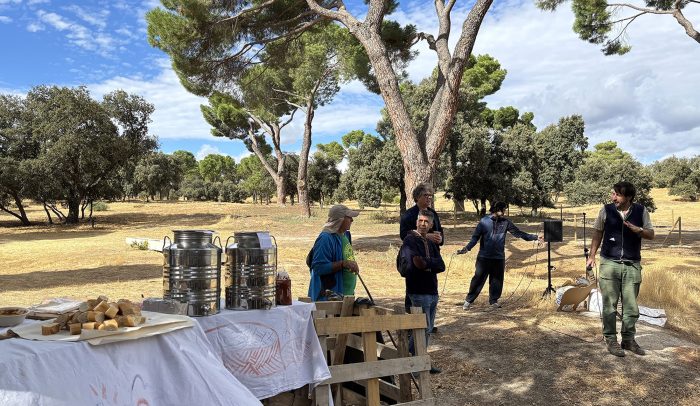
Joint lunch organized together with INLAND-Campo Adentro in the Casa de Campo, Madrid.

Joint lunch organized together with INLAND-Campo Adentro in the Casa de Campo, Madrid.

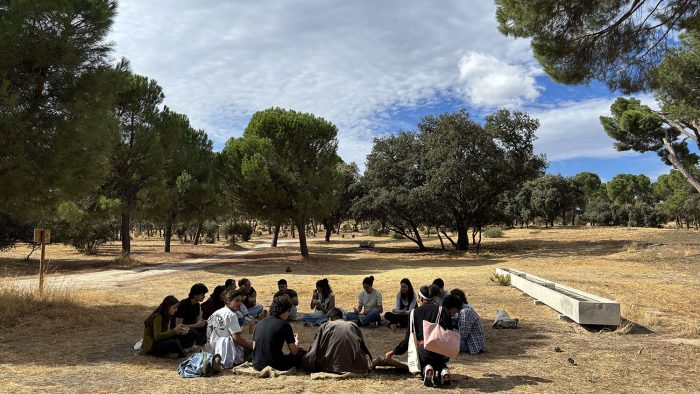
Interactive educational activities related to the concept of landscape in Casa de Campo, Madrid.

Interactive educational activities related to the concept of landscape in Casa de Campo, Madrid.

The conceptual approaches of the BIP align directly with the objectives of the Heritagescapes research project, dedicated to the critical mapping of metropolitan cultural landscapes and the identification of emerging heritage futures. Reflection on the processes of museumisation of urban spaces, the reconsideration of beauty from ecological parameters, and the analysis of diversity—social, biological, and cultural—allow us to move towards new interpretations of contemporary heritage and its possible futures. The workshop’s emphasis on dissolving dichotomies, interpreting territories relationally, and attending to historical, socio-ecological, and aesthetic dynamics provides an operational framework that reinforces the project’s methodologies, particularly regarding the construction of critical maps, the identification of non-institutionalized cultural values, and the understanding of landscape as a dynamic assemblage. This connection allows the analytical practices developed in the BIP to act as a research laboratory, generating hypotheses, debates, and materials that contribute to advancing knowledge about contemporary cultural landscapes and their future management.

Guided tour and fieldwork at Cerro Almodóvar, one of the five case studies selected for the workshop, on the outskirts of Madrid.

Guided tour and fieldwork at Cerro Almodóvar, one of the five case studies selected for the workshop, on the outskirts of Madrid.

This BIP workshop brought together four partner institutions from Spain, Portugal, Italy, and Germany, offering students and academics the opportunity to participate in an intensive learning project within an interdisciplinary and multicultural team. The proposal sought to extend and deepen the exchanges and debates that had been initiated in Lisbon, within the framework of the BIP “Living in Lisbon”, and continued in Frankfurt, in the BIP “Spatial Practices and Housing in Frankfurt.” In both of these experiences, the institutions involved were those that later proposed this third edition: Universidad Politécnica de Madrid, ISCTE, and Goethe University Frankfurt. In this fourth edition, the team was joined by the Politecnico di Milano. Furthermore, the team of universities was enriched by the notable participation of the Madrid City Council, the Madrid Institute of Architects (COAM), and the Ministry of Housing and Urban Agenda, through La Casa de la Arquitectura (LCA)—all of them flagships in the fields of architecture and heritage, both in Spain and across Europe.

Final presentation of the video essays produced by the work teams in the auditorium of the La Casa de la Arquitectura museum.

Final presentation of the video essays produced by the work teams in the auditorium of the La Casa de la Arquitectura museum.

In short, this fourth edition of the BIP has reaffirmed the value of collaborative and interdisciplinary learning as a means of critically reflecting on contemporary architectural, urban, and landscape practices. The wealth of diverse perspectives and institutional partnerships has also contributed to building a solid common framework for understanding the complex and evolving relationships between heritage, space, and society.


The Frontline Around Madrid: Comparison Between Battle Maps and War Remnants Density Maps of the Spanish Civil War in Madrid

Nicolás Mariné

Curating Heritage. On the Future of the Past in the Everyday Landscape of the Metropolis of Madrid

Rodrigo de la O and Eduardo de Nó

Everyday heritage: Representation and landscape in the region of Madrid

David Escudero and Diego Toribio

Architecture and landscapes for agricultural research in Madrid: documenting scientific and technological heritage

Rodrigo de la O and Eduardo de Nó

Are We What We Eat? A Heritage Perspective on the Agri-food Landscapes of the Madrid Region

David Escudero, Beatriz Pereira

Water to Feed Madrid: 18 km of Orchards and Nurseries Along the Course of the Canalillo

Carmen Toribio

Gardens of yesterday and today, their persistence in the City of Madrid: Comparative study of the Transformation of Private Gardens in Madrid

Lucía Gamboa Sánchez Blanco

Vestige, Signal and Onset of an Event: Sundays at the Rastro

Marina Gil Escalada

Reclaiming the City Through Its River: The Case of the Manzanares

Claudia Rivera Lario

Domestic Architecture in the Sierra de Guadarrama: 20th Century

Guillermo García Prieto

Industrial Madrid: evolution and permanences Around Atocha

Marta Abadín García

Devices of the Real, Collective Devices

Carlo Udina Rodríguez

Between the Playful and the Working-Class: An Atlas of Goya’s Madrid

Juan Castro Sánchez

Towards a Master Plan for the Landscape of Light: Paseo del Prado and Buen Retiro, Landscape of Arts and Sciences

Pablo Jaque Valdés

From water to landscape: the transformation of the Royal Site of Aranjuez through Hydraulic Engineering

Carlos Corisa Andarias

From the kitchen to the landscape. Architectures of Cocido in Madrid.

Beatriz Pereira

Among productive landscapes: the former El Águila brewery in Villaverde, Madrid.

Diego Sacristán

Adaptive reuse and heritage practice: Origins, meanings and strategies

Graziella Trovato

Unveiling Madrid’s Visual Imagery: An Ongoing Attempt

David Escudero

Navigating the Meaques Stream in the Casa de Campo

Clara Cernou

The water footprints of enlightened Madrid and the hydraulic legacy of Juan de Villanueva

Eugenia Abejón

Transhumance Landscapes and Nature-Based Tourism

Cecilia Arnaiz and Marifé Schmitz

Castle of Villaviciosa de Odón: A Scientific Heritage of Forestry Research and Education

Eduardo de Nó

Heritage Networks in Villaverde’s Industrial Landscape

Rafael Guerrero

Ecology of the Royal Sites: The Livestock Trails of El Escorial

Eva Calderón

Co-Design in Urban Framing

Finca formativa "Huerto El Pozo"

The GIPC

Rethinking Public Spaces through Urban Farming

Concha Lapayese, Francisco Arques y Diego Martín-Sánchez

Unveiling Agricultural Heritage

Marina López-Sánchez

Historic Nurseries: A Cultural and Natural Legacy in Transformation

Carmen Toribio

Hydraulic Heterotopias: The Image of Technique

Carmen Toribio

Surrounding the Non-Urbanized Villa de Vallecas

Marina López-Sánchez

Curating Heritage Ecologies

Presentation of the workshop main goals in the Conference Room of the Madrid School of Architecture ETSAM.
Guided tour and fieldwork in Cerro Almodóvar, one of the five case studies selected for the workshop, in the outskirts of the city.
Joint lunch organized together with INLAND-Campo Adentro in the Casa de Campo, Madrid.
Interactive educational activities related to the concept of landscape in Casa de Campo, Madrid.
Guided tour and fieldwork at Cerro Almodóvar, one of the five case studies selected for the workshop, on the outskirts of Madrid.
Final presentation of the video essays produced by the work teams in the auditorium of the La Casa de la Arquitectura museum.